
Djara Cave Egypt: Complete Travel Guide, Safari & Desert Tours
Djara Cave Egypt is one of the most unusual natural and archaeological destinations hidden in Egypt’s Western Desert.
Far beyond Cairo’s busy streets and the famous monuments of the Nile Valley, Djara offers a completely different kind of Egyptian experience: a remote limestone cave filled with natural formations, prehistoric rock art and evidence of human activity in a landscape that today appears almost completely dry.
But Djara Cave is not simply an attraction that travelers drive to, spend an hour visiting and return from.
The journey itself is a major part of the experience.
A Djara Cave expedition can take travelers through some of the Western Desert’s most spectacular landscapes, including Bahariya Oasis, the Black Desert, Valley of Agabat, the White Desert and Crystal Mountain, depending on the chosen itinerary.
For adventure travelers, photographers and visitors looking for destinations beyond Egypt’s classic tourist circuit, Djara can therefore become the centerpiece of a deeper Western Desert journey.
Scientific research describes Djara as one of Egypt’s relatively rare richly decorated caves, containing stalactites, stalagmites, columns and flowstones as well as important prehistoric evidence.
At White Desert Egypt Tour, Djara is included in dedicated multi-day desert expeditions designed around 4×4 exploration, desert camping and the wider landscapes of the Western Desert.
This guide explains what Djara Cave is, where it is located, why its geology and prehistoric art are important, how to visit from Cairo, what to expect from the desert safari, how many days you need, when to travel, what to pack and which tour combines Djara with the White Desert.
Want to experience Djara Cave instead of only reading about it?
3 Days Siwa Oasis Tour from Cairo – Great Sand Sea Safari & Oasis Experience
3 Days / 2 Nights Siwa Oasis Tour from Cairo This 3-day Siwa Oasis tour from Cairo is perfect for…
5 Days Siwa Oasis Tour from Cairo – Marsa Matrouh & Great Sand Sea Safari
🏜️ Cairo – Marsa Matrouh – Siwa – Cairo 5 Days / 4 Nights Siwa Oasis Tour from Cairo This…
7 Days Siwa & White Desert Tour from Cairo – Ultimate Western Desert Expedition
🏜️ 7 Days Siwa & White Desert Tour from Cairo North Coast – Siwa – Bahariya – White Desert (7…
White Desert & Whale Valley Tour from Cairo – 3 Day Desert & Fossil Adventure
🏜️ White Desert & Whale Valley Tour from Cairo Cairo – Bahariya – White Desert – Wadi El Hitan –…
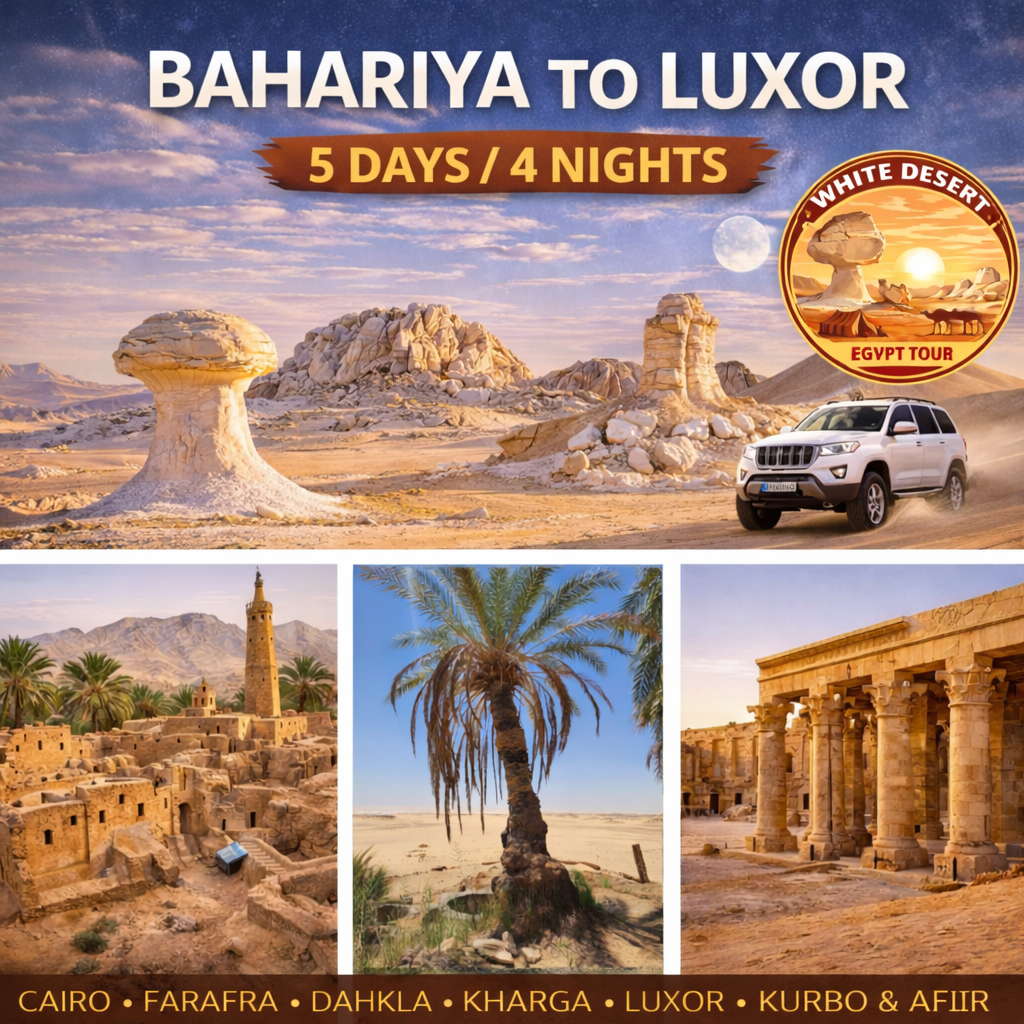
Western Desert Tour from Cairo to Luxor – 5 Day Multi-Oasis Desert Expedition
5 Days / 4 Nights Multi-Oasis Expedition This Western Desert Tour from Cairo to Luxor is a full desert expedition…
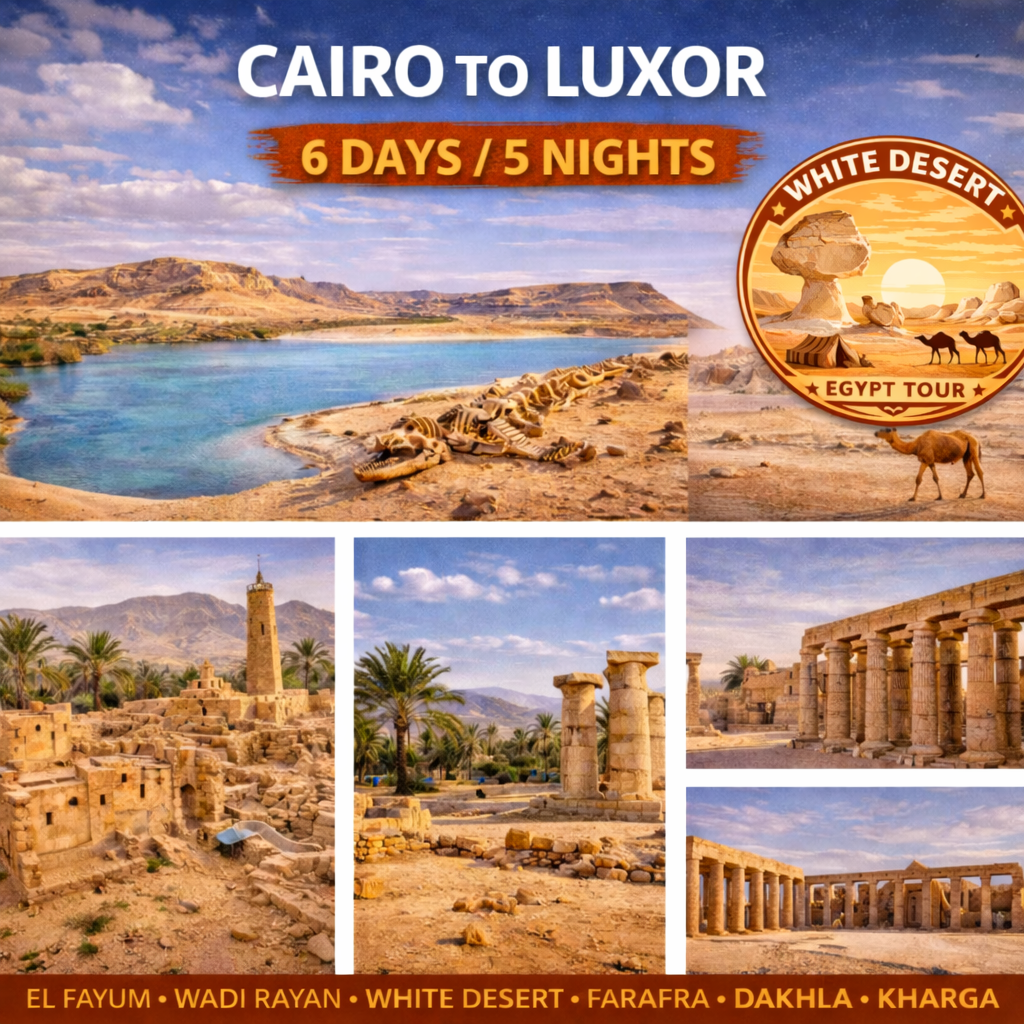
6 Days Western Desert Expedition – Cairo to Luxor Oasis & Desert Safari
🏜️ 6 Days Western Desert Expedition Cairo → Fayoum → White Desert → Dakhla → Kharga → Luxor This 6-day…
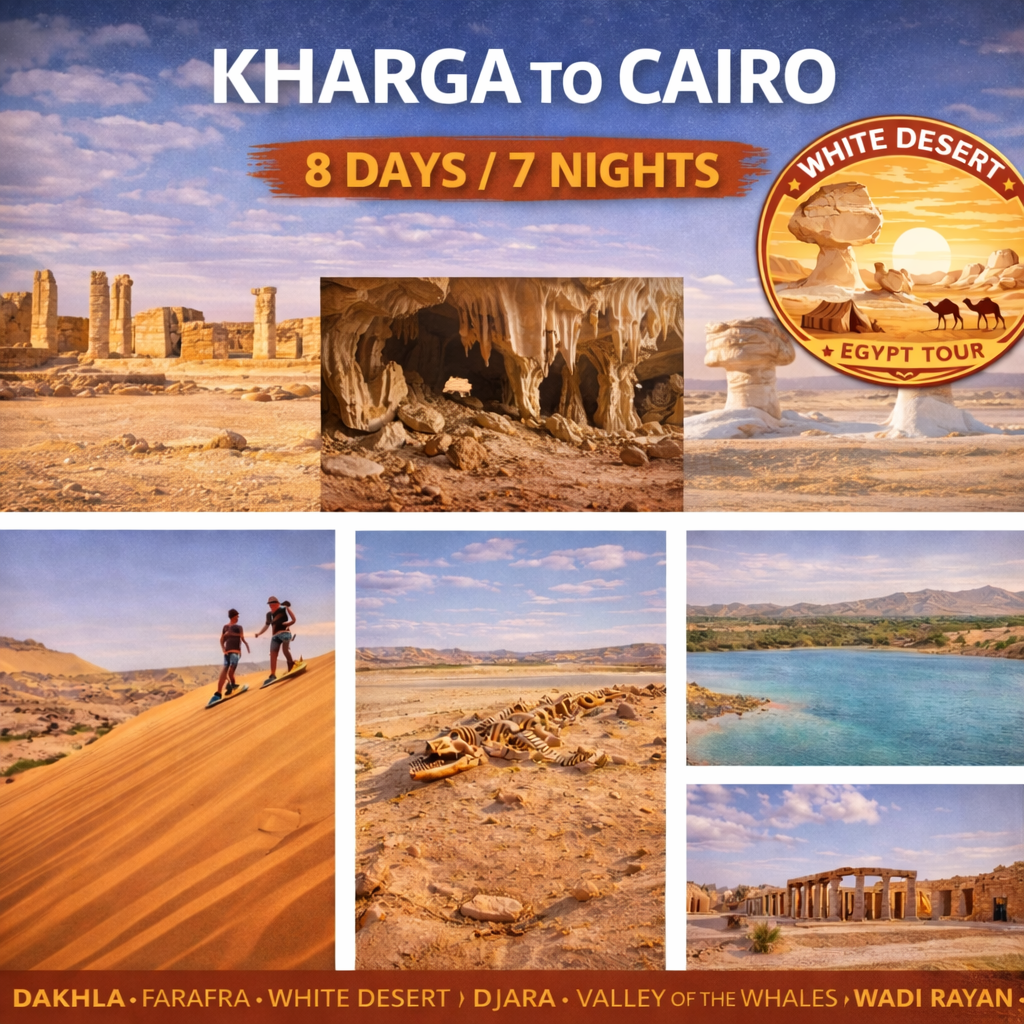
8 Days Western Desert Expedition – Kharga to Cairo Oasis & Desert Adventure
🏜️ 8 Days Western Desert Expedition (Kharga to Cairo) Kharga → Dakhla → Farafra → White Desert → Djara Cave…
Where Is Djara Cave in Egypt?
Djara Cave is located deep within Egypt’s Western Desert, on the Egyptian Limestone Plateau.
Academic archaeological research describes the cave as lying approximately halfway between the Nile Valley around Asyut and Farafra Oasis, rather than being a conventional roadside attraction beside one of Egypt’s main tourist towns.
That remote geography is important when planning a visit.
You cannot approach Djara in the same way you would visit the Pyramids of Giza, a museum in Cairo or a temple in Luxor.
The cave forms part of a desert environment where off-road navigation, vehicle preparation, supplies and current access conditions matter.
For tourism itineraries departing from Cairo, Djara is commonly incorporated into a wider Western Desert expedition connected with Bahariya Oasis and the White Desert.
Your journey may therefore look broadly like:
Cairo → Bahariya Oasis → Western Desert landscapes → Djara Cave → White Desert → Bahariya → Cairo
The exact route can vary according to current desert conditions, permissions and itinerary design.
If this is your first time exploring this part of Egypt, start with our Bahariya Oasis Egypt guide and our complete White Desert Egypt travel guide.
Djara Cave and the Western Desert Route
Djara becomes much easier to understand when you see how it relates to the surrounding desert destinations.
Instead of thinking of these attractions as completely separate trips, a longer desert expedition can connect dramatically different landscapes in the same journey.
The dark hills of the Black Desert Egypt contrast with the pale formations of the White Desert.
The sparkling geological features of Crystal Mountain Egypt offer another change in scenery.
And Djara adds something completely different again: exploration below the desert surface.
This diversity is one reason the Djara route works particularly well for travelers who already know they want more than a standard overnight White Desert trip.
What Is Djara Cave?
Djara is a natural dripstone cave within the limestone landscape of Egypt’s Western Desert.
Its interior contains forms that travelers usually associate with caves in much wetter parts of the world: stalactites descending from the ceiling, stalagmites rising from the floor, columns and flowstone deposits.
Published geological research describes some of Djara’s speleothems as exceptionally substantial and identifies the cave as one of relatively few well-decorated caves in Egypt.
That immediately raises an interesting question:
How did formations created by water develop in today’s extremely arid desert?
That is part of what makes Djara scientifically interesting.
Research into the age and chemistry of its cave deposits has helped scientists investigate earlier climatic periods when this part of North Africa experienced very different environmental conditions. Studies of the speleothems indicate formation during much wetter climatic episodes long before the current desert environment developed.
So when you stand inside Djara Cave, you are not simply looking at attractive rock formations.
You are looking at physical evidence that the Sahara and surrounding regions have changed dramatically over immense periods of time.
Stalactites, Stalagmites and Cave Formations
The geological formations are one of Djara Cave’s defining features.
Inside, visitors can encounter several types of speleothems, including:
- stalactites;
- stalagmites;
- columns;
- flowstone;
- naturally sculpted limestone surfaces.
A peer-reviewed study published in Cave and Karst Science reported stalactites, columns, stalagmites and flowstones at Djara, with some formations reaching impressive dimensions.
The formations developed through processes involving water moving through the limestone and depositing minerals over extremely long periods.
Today that creates an almost surreal contrast.
Outside is an immense dry desert.
Inside is evidence of ancient water and earlier climatic conditions.
For travelers interested in geology, that story often makes Djara even more impressive than its appearance alone.
Prehistoric Rock Art at Djara Cave
Djara Cave is also important because of its prehistoric rock art.
Archaeological researchers documented a significant collection of incised figures inside the cave, making Djara particularly valuable for studying human presence in the northern Western Desert.
Research by the University of Cologne’s ACACIA project examined the cave’s rock-art repertoire and its relationship to prehistoric human activity and changing environmental conditions.
This gives Djara a second identity.
It is both:
a geological site telling a story about ancient climate,
and
an archaeological site preserving evidence of people who once moved through a landscape very different from the desert travelers see today.
Researchers have also found archaeological evidence in and around the cave indicating human visits during prehistoric periods.
Visitors should therefore treat the site carefully.
Rock art, cave formations and archaeological traces should never be touched, scratched, climbed on or removed.
A photograph lasts much longer than a souvenir taken from an irreplaceable archaeological landscape.
History and Rediscovery of Djara Cave
Modern accounts of Djara are associated with the German explorer Gerhard Rohlfs, whose Western Desert expeditions helped document remote areas of Egypt in the nineteenth century.
Sources disagree slightly over whether the relevant journey should be dated 1873 or 1874, so I would not use the previous sentence “first documented in 1874” as an absolute fact without qualification.
For the SEO page, the cleaner and safer wording is:
“Djara Cave became known to European explorers through the nineteenth-century Western Desert expeditions of Gerhard Rohlfs and was later studied by modern geological and archaeological teams.”
That keeps the important historical context without creating an unnecessary date dispute.
Modern scientific work has been considerably more important for understanding the cave.
Geological research investigated Djara’s morphology and ancient climatic evidence, while archaeological projects documented its rock art and prehistoric human presence.
For visitors today, that combination of exploration history, geology and archaeology is one of the reasons Djara feels so different from more conventional desert sightseeing stops.
Why Visit Djara Cave Egypt?
Djara is not the right destination for every Egypt traveler.
If this is your first trip to Egypt and you only have four or five days in the entire country, Cairo and the Nile Valley will probably be higher priorities.
But if you want adventure, remote landscapes and a less conventional side of Egypt, Djara becomes much more interesting.
1. It Is Different from the Classic White Desert Route
A standard White Desert trip already provides exceptional scenery.
Adding Djara takes you farther into the expedition side of Western Desert travel.
Instead of focusing only on surface landscapes, you add cave exploration and prehistoric archaeology to the experience.
2. The Journey Is Part of the Attraction
The road to Djara is not wasted travel time.
Crossing remote Western Desert landscapes in a 4×4 is a major part of why people choose this trip.
3. It Combines Nature and Archaeology
Few Western Desert stops combine geological formations and prehistoric human evidence so directly.
4. It Suits Travelers Looking for Remote Places
Djara is far removed from Egypt’s busiest tourism centers.
That remoteness means more complicated logistics, but it is also central to the destination’s appeal.
5. It Fits Naturally with the White Desert
Travelers do not need to choose between the two.
A multi-day route can include both.
For an overview of exactly how these destinations work together, read our White Desert and Djara Cave Safari guide.
How to Visit Djara Cave from Cairo
For most international visitors, Cairo is the logical starting point.
However, Djara should not be approached as a day excursion from the capital.
The distance, desert terrain and number of worthwhile places along the route make a multi-day itinerary much more sensible.
A practical organized journey generally begins with transportation from Cairo toward Bahariya Oasis.
From there, travelers transfer into the desert portion of the trip and continue by appropriate off-road vehicles.
The current White Desert Egypt Tour Djara itinerary is a 3-day / 2-night private customizable safari starting and ending in Cairo, with 4×4 desert transportation during the safari sections.
That itinerary currently combines Djara with Bahariya, Black Desert, El Haize, Valley of Agabat, White Desert and Crystal Mountain.
View the actual itinerary:
What to Expect on a Djara Cave Desert Safari
A Djara Cave safari should feel more like a small expedition than a conventional sightseeing tour.
You will spend substantial time traveling through desert environments.
That means the experience includes not only the destinations but also:
- off-road driving;
- desert tracks;
- changing landscapes;
- outdoor meals;
- camping;
- long periods away from towns;
- limited conventional services;
- sunrise and sunset in remote surroundings.
On the site’s current 3-day Djara itinerary, the route begins from Cairo and Bahariya before crossing several Western Desert landscapes. Day two focuses on Djara Cave before continuing toward White Desert camping, and the final day explores the White Desert and Crystal Mountain before returning through Bahariya to Cairo.
That combination is important because Djara alone does not need to consume the entire expedition.
Instead, the cave becomes one major highlight inside a broader journey.
Black Desert
The Black Desert creates one of the first major visual contrasts on many Western Desert routes.
Dark stones and hilltops give the terrain an appearance completely different from the pale scenery travelers later encounter around the White Desert.
If you have never visited the area before, read our full Black Desert Egypt guide.
Valley of Agabat
The Valley of Agabat is another landscape included on the current Djara itinerary.
Golden sand and dramatic rock formations make the area particularly attractive for photography and off-road exploration.
The important thing is not to rush every stop simply because the itinerary contains many locations.
A strong desert experience should leave some time to get out of the vehicle, walk, photograph and actually experience the scale of the landscape.
White Desert Egypt
The White Desert is usually the most famous destination on the wider route.
Its pale chalk formations look completely different from both Djara Cave and the Black Desert.
For first-time Western Desert visitors, combining Djara and the White Desert provides an excellent introduction to the geological diversity of this region.
Read our complete White Desert Egypt guide before traveling.
Crystal Mountain
Crystal Mountain is another well-known geological stop on the route.
The current 3-day Djara tour includes Crystal Mountain while traveling back toward Bahariya on the final day.
For more detail about what it is and what visitors actually see, use our Crystal Mountain Egypt guide.
Camping on a Djara Cave Expedition
Camping is one of the experiences that turns a Djara journey into a real desert expedition.
On White Desert Egypt Tour’s current 3-day Djara itinerary, both nights are camping-based, including a desert camp on the first night and White Desert camping on the second.
Instead of returning to a hotel after each day’s sightseeing, you remain inside the desert environment.
A typical camp experience can include:
- prepared evening meals;
- drinking water;
- mattresses and camping equipment;
- tea;
- sunset;
- night sky;
- sunrise the following morning.
The site’s current tour lists camping equipment, meals and drinking water among its inclusions.
Travelers should nevertheless understand that desert camping is not the same as hotel accommodation.
Comfort levels, facilities and temperatures are different.
If camping is a major concern for you, read our detailed White Desert camping guide before choosing the trip.
Stargazing in the Western Desert
Night is one of the most memorable parts of a remote desert journey.
Once the vehicle stops and the day’s driving is over, the atmosphere changes completely.
There are no busy city streets outside camp.
The landscape becomes quiet and dark.
That makes evenings suitable for relaxing around camp and looking at the night sky.
Photographers who want to capture stars should prepare before traveling because night photography requires different equipment and camera settings from ordinary daytime sightseeing.
Our White Desert photography tips are useful for anyone planning to photograph the wider Djara and White Desert expedition.
How Many Days Do You Need for Djara Cave?
For travelers coming from Cairo, three days is the practical starting point for the dedicated route currently offered by White Desert Egypt Tour.
This is an important change from the old copy, which said “2–3 days minimum.”
I would avoid presenting two days as the standard Djara option.
A classic White Desert route can work in two days, but adding Djara creates a deeper itinerary that benefits from additional time.
3 Days
Best for travelers who want:
- Djara Cave;
- White Desert;
- Black Desert;
- desert camping;
- major route highlights;
- departure and return from Cairo.
View the 3-Day Djara Cave Safari →
4 Days
An extra day can allow a slower pace, longer photography stops or additional desert exploration when operationally possible.
This is worth considering if you dislike compressed itineraries.
Longer Western Desert Expeditions
Djara can also form part of much longer Western Desert routes.
Your current 8 Days Western Desert Expedition includes Djara Cave as a key highlight on Day 4 and combines it with a wider multi-oasis journey.
Djara Cave vs a Classic White Desert Tour
This is an important question for travelers deciding how much time to spend in the Western Desert.
A classic White Desert tour is better if:
- you only have around two days;
- it is your first desert experience;
- your priority is White Desert camping;
- you want the most famous highlights without a deeper expedition.
A Djara Cave expedition is better if:
- you have at least three days;
- you enjoy archaeology and geology;
- you want more off-road exploration;
- you prefer remote destinations;
- you have already decided that desert travel is a major part of your Egypt itinerary.
For travelers comparing shorter White Desert options, see our 2-day vs 3-day vs 4-day White Desert itinerary guide.
Best Time to Visit Djara Cave
Because Djara is part of a remote Western Desert expedition, weather affects more than sightseeing comfort.
Travelers will spend substantial time outdoors and may camp overnight.
For many visitors, the cooler period of the year is therefore more suitable than peak summer conditions.
When planning the wider White Desert route, October through April is generally the season most international travelers consider for comfortable desert exploration.
Conditions vary throughout that period.
Winter days can be pleasant for outdoor activities, while nights may become considerably colder.
Autumn and spring can provide warmer conditions without the same intensity associated with summer.
Weather should always be checked shortly before the expedition because desert conditions can vary.
For detailed seasonal planning, read our best time to visit White Desert Egypt.
What to Pack for a Djara Cave Safari
Packing should reflect two environments:
the cave and the open desert.
Useful personal items include:
- comfortable closed shoes;
- lightweight daytime clothing;
- warmer layers for evening and early morning;
- sun hat;
- sunglasses;
- sunscreen;
- personal medication;
- toiletries;
- small day bag;
- power bank;
- camera or phone;
- protection for electronics against sand and dust;
- a headlamp or flashlight if advised for the cave visit;
- sufficient personal essentials for several days away from urban services.
Your tour operator should clearly explain what camping equipment, food and water are supplied.
The current dedicated Djara tour lists camping equipment, meals and drinking water as included.
For a wider checklist, use our guide to what to pack for White Desert Egypt.
Djara Cave Tour Cost
There is no single universal Djara Cave tour price.
The cost can depend on:
- number of travelers;
- trip length;
- private or shared format;
- Cairo transportation;
- 4×4 desert transportation;
- camping arrangements;
- meals and water;
- route;
- additional nights;
- customization;
- travel season;
- current operating requirements.
Your current dedicated Djara product is listed as a private, customizable 3-day safari and states that pricing varies according to travel preferences, group size, tour format and season.
That means travelers should compare inclusions, not just the cheapest headline price.
A normal two-day White Desert tour and a remote three-day Djara expedition do not involve the same route or logistics.
Want the current price for your dates?
Check the 3 Days White Desert & Djara Cave Safari →
Or browse all Western Desert tours.
Is Djara Cave Safe to Visit?
This section needs careful wording because Djara is in a remote part of Egypt’s Western Desert.
We should not tell international visitors that the destination is simply “safe” without qualification.
Current government travel advice differs by nationality.
As of August 2026, the U.S. Department of State advises against travel in Egypt’s Western Desert unless traveling with a professionally licensed tour company.
France’s Ministry for Europe and Foreign Affairs distinguishes parts of the Western Desert and recommends heightened vigilance in the White Desert/Farafra region, secure routes, suitable equipment, and using a recognized agency or local guide.
Travelers should therefore:
- check the latest advice issued by their own government;
- confirm current access conditions before departure;
- travel with an experienced, appropriately licensed operator;
- follow instructions from Egyptian authorities;
- use suitable 4×4 vehicles;
- carry adequate water and supplies;
- avoid attempting remote desert navigation independently;
- expect limited connectivity;
- stay on the agreed route;
- avoid restricted or border areas.
Conditions and access requirements can change, so arrangements should be reconfirmed shortly before travel.
Can You Visit Djara Cave Independently?
For practical tourism purposes, Djara is not a destination we recommend attempting independently.
The issue is not simply finding the cave entrance.
Travelers have to deal with remote desert navigation, vehicle suitability, fuel, water, food, communication, current access requirements and emergency planning.
The U.S. travel advisory specifically states that Western Desert travel should be with a professionally licensed tour company, reinforcing the importance of organized travel for U.S. visitors.
Even experienced international travelers should not treat a remote Western Desert route like an ordinary self-drive excursion.
Who Is the Djara Cave Tour Best For?
Adventure Travelers
Djara is particularly attractive if you enjoy reaching destinations that require effort rather than simply arriving by coach.
The off-road route is part of the experience.
Photographers
You get multiple photographic environments in one expedition:
dark hills, dunes, limestone cave formations, White Desert landscapes, sunset, sunrise and camp.
Couples
A private desert expedition can work particularly well for couples who prefer nature, silence and adventure over conventional resort travel.
Solo Travelers
Solo travelers can also visit as part of an appropriately organized trip, but cost and private/shared arrangements should be checked beforehand.
Geology and Archaeology Travelers
Djara has considerably more depth for travelers interested in geology or prehistory than a normal scenic stop.
The cave’s speleothems have been scientifically studied for evidence of ancient climatic conditions, while its rock art has been documented archaeologically.
Is Djara Cave Worth Visiting?
Djara Cave is worth visiting for the right traveler.
If you want only Egypt’s most famous attractions, it probably should not replace Cairo, Giza or Luxor on a very short first trip.
But if you are already planning a Western Desert adventure and have enough time to go beyond the classic route, Djara adds something genuinely different.
The appeal comes from the complete experience:
the long desert journey,
the isolation,
the 4×4 route,
the cave itself,
its natural formations,
prehistoric rock art,
desert camping,
and the opportunity to combine it with the White Desert and other landscapes.
That makes Djara particularly valuable for travelers who do not simply want to “see another attraction.”
They want the journey to feel like an expedition.
Plan Your Djara Cave & White Desert Tour
If you have only two days available, a classic White Desert tour may be the better choice.
If you have three days and want something more adventurous, add Djara Cave.
If you have significantly more time, consider a longer Western Desert expedition.
For the most direct Djara experience from Cairo, our current itinerary combines:
Cairo → Bahariya Oasis → Black Desert → Valley of Agabat → Djara Cave → White Desert → Crystal Mountain → Cairo.
Ready to explore Djara Cave?
View the 3 Days White Desert & Djara Cave Safari →
Or:
Explore All Egypt Desert Tours →
Contact White Desert Egypt Tour with your travel dates, number of travelers and preferred itinerary to discuss the most suitable desert route.
3 Days Siwa Oasis Tour from Cairo – Great Sand Sea Safari & Oasis Experience
3 Days / 2 Nights Siwa Oasis Tour from Cairo This 3-day Siwa Oasis tour from Cairo is perfect for…
5 Days Siwa Oasis Tour from Cairo – Marsa Matrouh & Great Sand Sea Safari
🏜️ Cairo – Marsa Matrouh – Siwa – Cairo 5 Days / 4 Nights Siwa Oasis Tour from Cairo This…
7 Days Siwa & White Desert Tour from Cairo – Ultimate Western Desert Expedition
🏜️ 7 Days Siwa & White Desert Tour from Cairo North Coast – Siwa – Bahariya – White Desert (7…
White Desert & Whale Valley Tour from Cairo – 3 Day Desert & Fossil Adventure
🏜️ White Desert & Whale Valley Tour from Cairo Cairo – Bahariya – White Desert – Wadi El Hitan –…
Western Desert Tour from Cairo to Luxor – 5 Day Multi-Oasis Desert Expedition
5 Days / 4 Nights Multi-Oasis Expedition This Western Desert Tour from Cairo to Luxor is a full desert expedition…
6 Days Western Desert Expedition – Cairo to Luxor Oasis & Desert Safari
🏜️ 6 Days Western Desert Expedition Cairo → Fayoum → White Desert → Dakhla → Kharga → Luxor This 6-day…
8 Days Western Desert Expedition – Kharga to Cairo Oasis & Desert Adventure
🏜️ 8 Days Western Desert Expedition (Kharga to Cairo) Kharga → Dakhla → Farafra → White Desert → Djara Cave…
FAQ About Djara Cave Egypt
Everything you need to know before visiting Djara Cave Egypt, including its location, prehistoric rock art, cave formations, transportation, camping, trip duration and Western Desert expeditions.
Djara Cave is located on the Egyptian Limestone Plateau in Egypt's Western Desert. Archaeological research describes it as lying roughly between the Nile Valley around Asyut and Farafra Oasis.
Djara Cave is famous for its limestone cave formations, including stalactites, stalagmites, columns and flowstones, as well as prehistoric rock art and archaeological evidence of ancient human visits.
For tourism itineraries, travelers typically travel from Cairo toward Bahariya Oasis and then continue through the Western Desert using appropriate 4×4 transportation as part of an organized multi-day expedition. White Desert Egypt Tour currently operates a 3-day itinerary combining Cairo, Bahariya, Djara and the White Desert.
Three days is a practical duration for a dedicated Djara Cave and White Desert safari from Cairo. Longer trips can add more Western Desert destinations and allow a slower pace.
A two-day itinerary is better suited to the classic White Desert route. Travelers specifically wanting Djara should generally allow additional time because the cave adds a more remote section to the journey.
Independent travel is not recommended because Djara lies in a remote Western Desert environment requiring appropriate vehicles, navigation, supplies and current access arrangements. International visitors should also check their government's latest Egypt travel advice before departure.
Yes. Geological research documents stalactites, stalagmites, columns and flowstone formations inside Djara Cave.
Yes. Archaeological research has documented an important collection of prehistoric incised rock art inside Djara Cave.
Because Djara is in the remote Western Desert, safety should not be described in absolute terms. Travelers should check current official advice, follow Egyptian access requirements and use experienced, appropriately licensed desert operators. Current U.S. guidance says Western Desert travel should be undertaken with a professionally licensed tour company.
Camping is commonly incorporated into multi-day Djara and White Desert expeditions. The current 3-day White Desert Egypt Tour itinerary includes two desert camping nights.
Depending on the itinerary, a Djara expedition can include Bahariya Oasis, Black Desert, Valley of Agabat, White Desert and Crystal Mountain. The current dedicated 3-day itinerary combines these areas in one journey.
The cooler months are generally more practical for Western Desert travel and camping. Travelers should check weather and current operating conditions before departure.
Bring comfortable closed footwear, sun protection, season-appropriate clothing, warmer layers for desert nights, personal medication, a power bank and protection for electronics from sand and dust. Confirm with your tour operator which camping equipment and supplies are included.
They offer different experiences. The White Desert is famous for its dramatic surface chalk formations and camping, while Djara adds cave geology and prehistoric rock art. Travelers with enough time can experience both in the same itinerary.
Yes, for travelers specifically interested in remote desert exploration, geology, archaeology and adventure. Because the journey requires significant travel time, it makes more sense as part of a multi-day Western Desert expedition than as a standalone short excursion.
White Desert Egypt Tour TripAdvisor reviews
3 Day and 2 Nights of Fun and Knowledge - This was one of the best experiences of my life. Our guides, Anas and Kareem, were so kind, helpful, and fun. From the food, sites, and experience everything was ABSOLUTELY... read more PERFECT. 100/10 would do again and recommend to any one.
jakewP7022KTOctober 15, 2026
An Unforgettable Experience in the White and Black Desert and the Bahariya Oasis. - I had an amazing and truly memorable tour with White Desert Egypt Tour. At first, I felt a little hesitant and worried because I was traveling alone. However, after booking... read more the trip, when I arrived at Bahariya Oasis and met Mohamed, the tour organizer, I immediately began to feel happy and comfortable. All my worries turned into hope and excitement for this beautiful experience.
From the very beginning of the trip, I felt as if I were surrounded by family, which made the experience even more comfortable and enjoyable for me. The White Desert, with its unique natural landscapes and stunning white rock formations, was an unforgettable experience. The Black Desert, with its beautiful geological formations, was also amazing. In addition, visiting Bahariya Oasis was a different and truly enjoyable experience.
My guide, Mohamed, was excellent and very helpful. He made sure that the trip was enjoyable and comfortable throughout. The transportation service was also very good and well organized, and the food was delicious and especially enjoyable after a long day full of adventure.
The service was excellent from the beginning until our return to Cairo, and the organization was outstanding. The driver was cooperative and respectful and always made sure that we were comfortable throughout the journey.
The tour was full of adventure and breathtaking natural scenery. I highly recommend it to anyone who wants to discover the beauty of the Egyptian desert in a unique way, especially solo travelers who may feel nervous about embarking on a new experience.
This is definitely an experience worth repeating!
Thank you to White Desert Egypt Tour and our guide Mohamed for the excellent organization and service, and for making this trip an unforgettable experience! 🙏
August 9, 2026
White Desert Tours - We would highly recommend Mohammad’s company for a trip to the White Desert. Very communicative and responsive throughout. The teams priority was to ensure clients had the best experience and... read more they certainly achieved that 100% from drivers meals relaxation photo stops everything was great. The White Desert is not to be missed a truly spectacular experience.
October 22, 2026