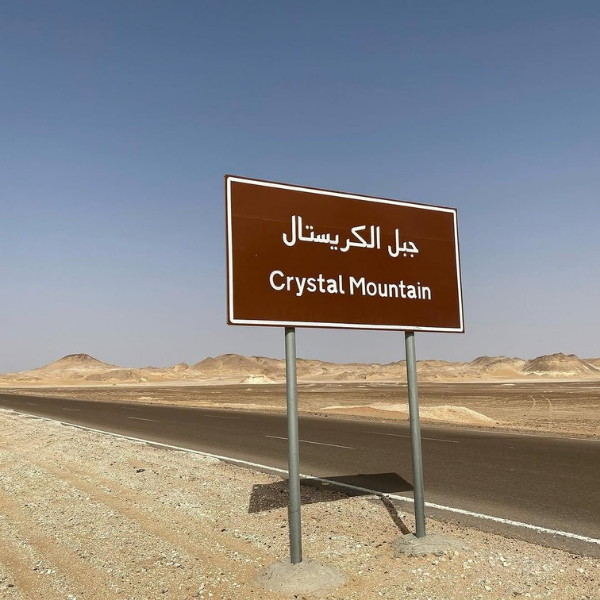
Crystal Mountain Egypt: Complete Visitor Guide, Geology & Desert Tours
Crystal Mountain Egypt is one of the most distinctive geological stops on the classic Western Desert route between Bahariya Oasis and the White Desert.
Despite its name, Crystal Mountain is not a conventional mountain rising high above the surrounding desert.
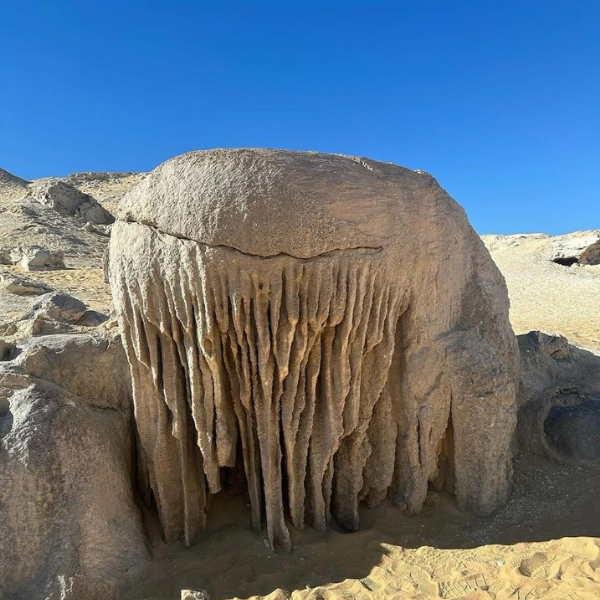
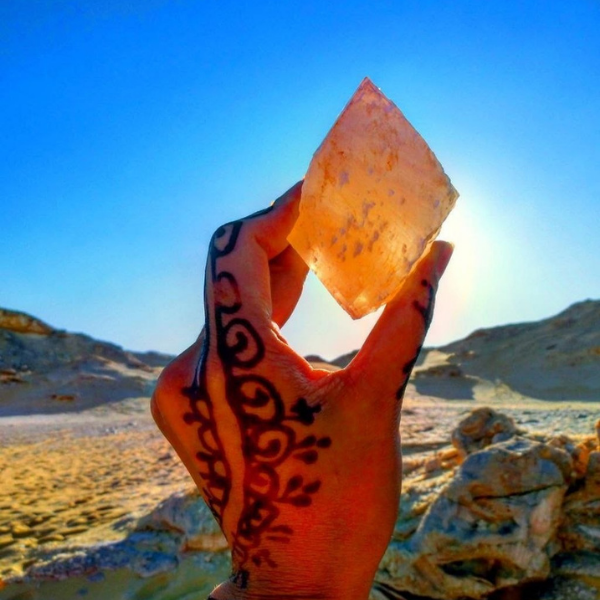
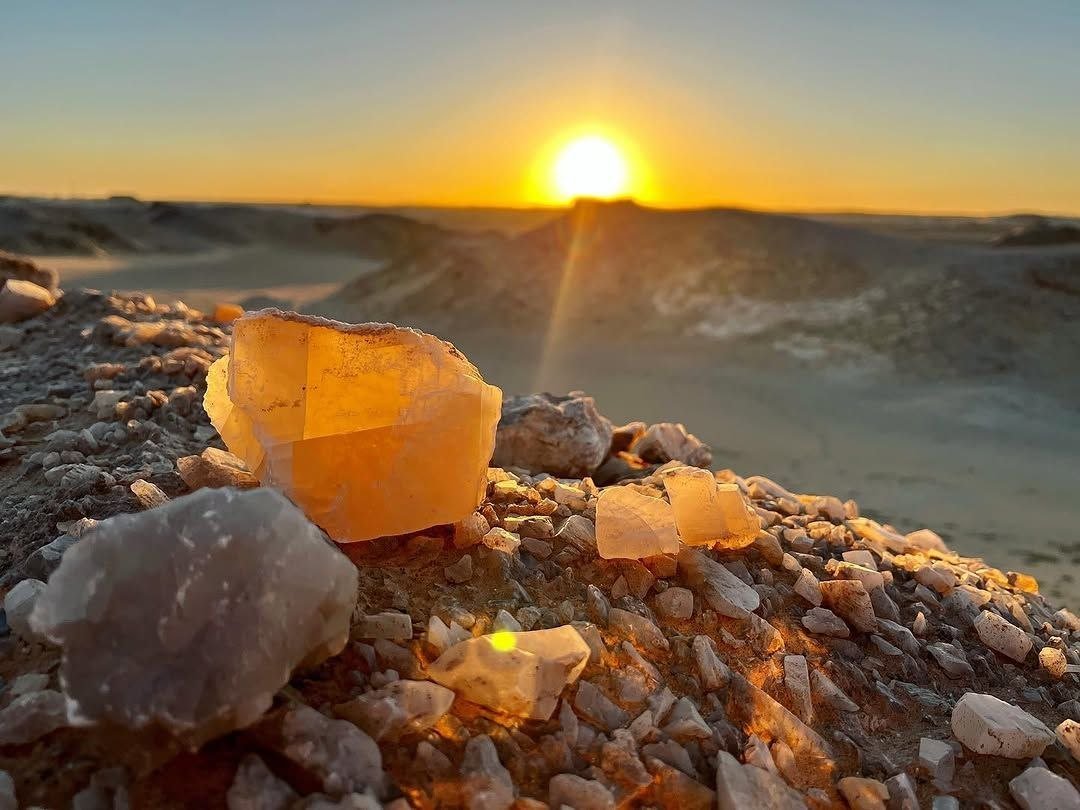
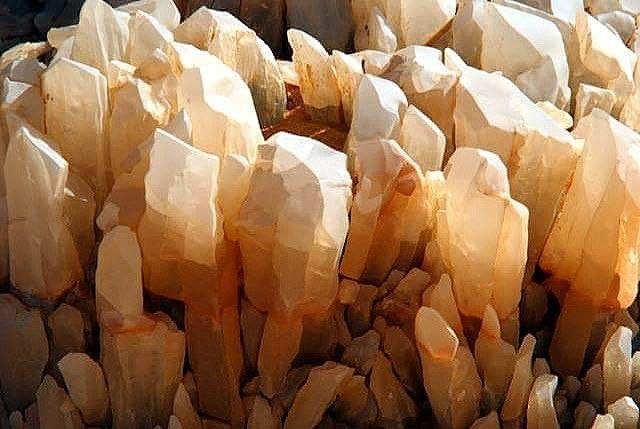
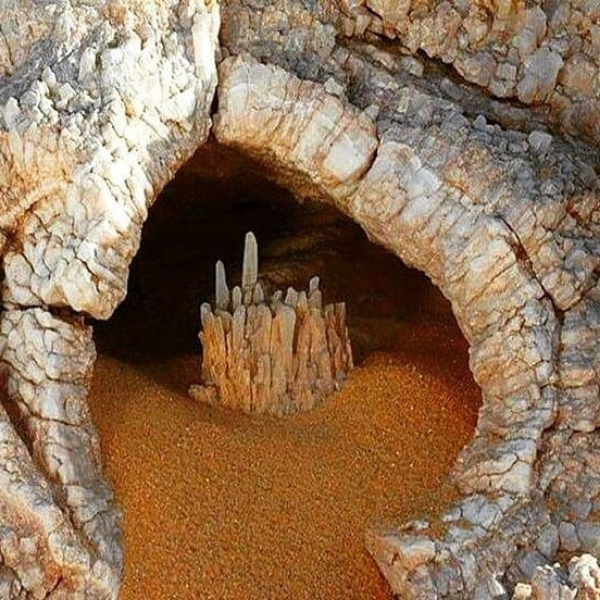
It is better understood as an exposed geological ridge and ancient karst feature, famous for its sparkling mineral formations, natural arch-like shapes and dramatic position in the open Western Desert.
Egypt’s official tourism website describes Crystal Mountain as a geological wonder of the White Desert and explains that the formation was once part of an underground cave that later became exposed at the surface.
That geological story is one of the reasons Crystal Mountain deserves more than the usual description of “a mountain covered in quartz.”
For travelers, however, its importance is also about location.
Crystal Mountain sits along one of Egypt’s most rewarding desert safari routes, linking several dramatically different landscapes:
Bahariya Oasis → Black Desert → El Haize → Crystal Mountain → Valley of Agabat → White Desert.
This means that within a single journey, travelers can move from green oasis landscapes to dark hills, sparkling mineral formations and finally the surreal white chalk scenery of the White Desert.
At White Desert Egypt Tour, Crystal Mountain is included in several of our Western Desert itineraries from Cairo, including the classic 2-day and 3-day White Desert routes.
Planning a Western Desert adventure?
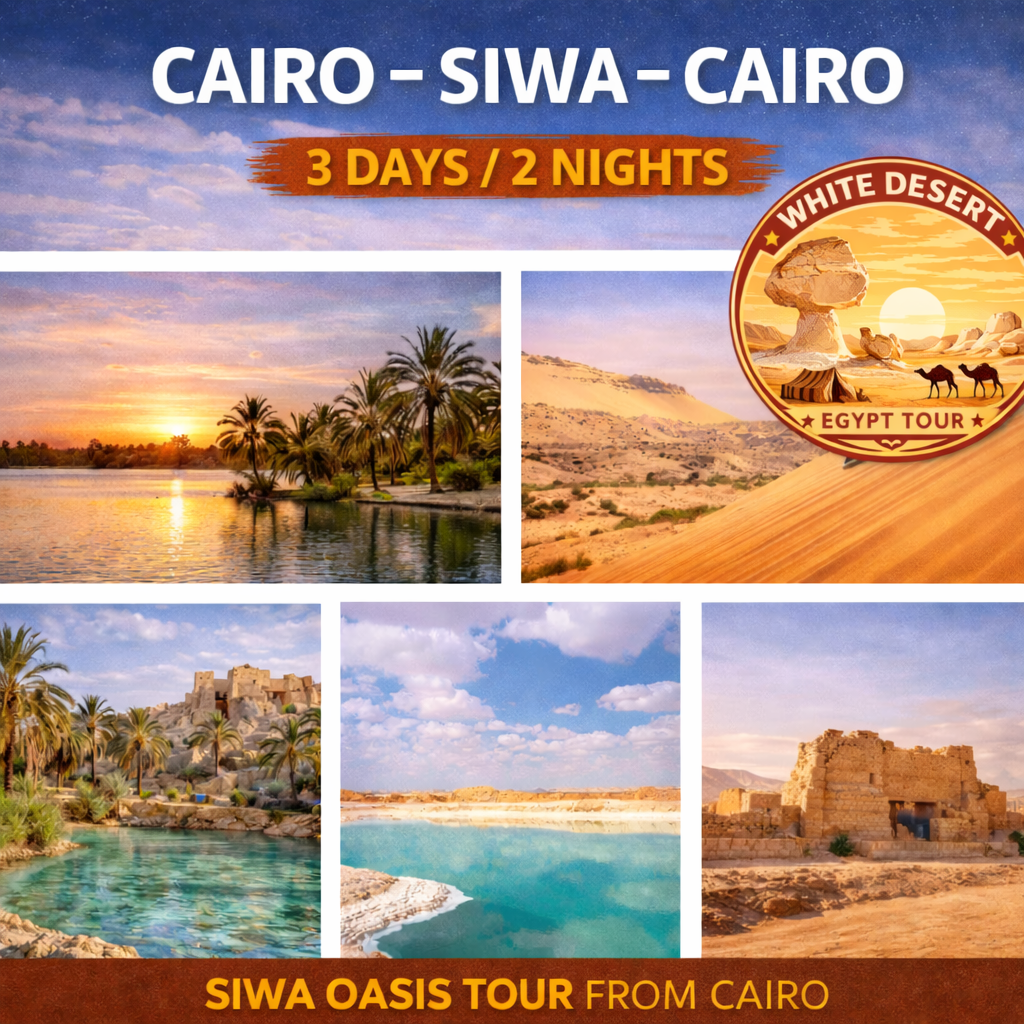
3 Days Siwa Oasis Tour from Cairo – Great Sand Sea Safari & Oasis Experience
3 Days / 2 Nights Siwa Oasis Tour from Cairo This 3-day Siwa Oasis tour from Cairo is perfect for…
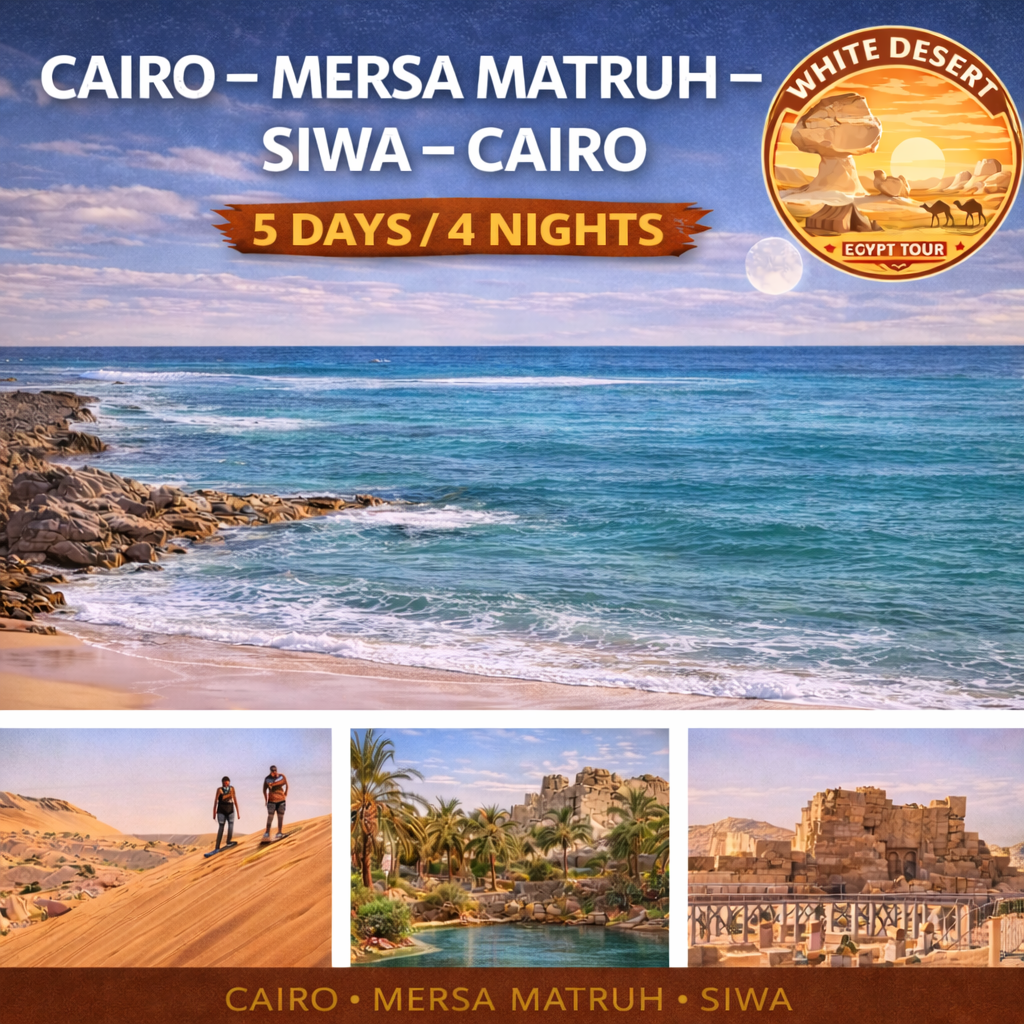
5 Days Siwa Oasis Tour from Cairo – Marsa Matrouh & Great Sand Sea Safari
🏜️ Cairo – Marsa Matrouh – Siwa – Cairo 5 Days / 4 Nights Siwa Oasis Tour from Cairo This…
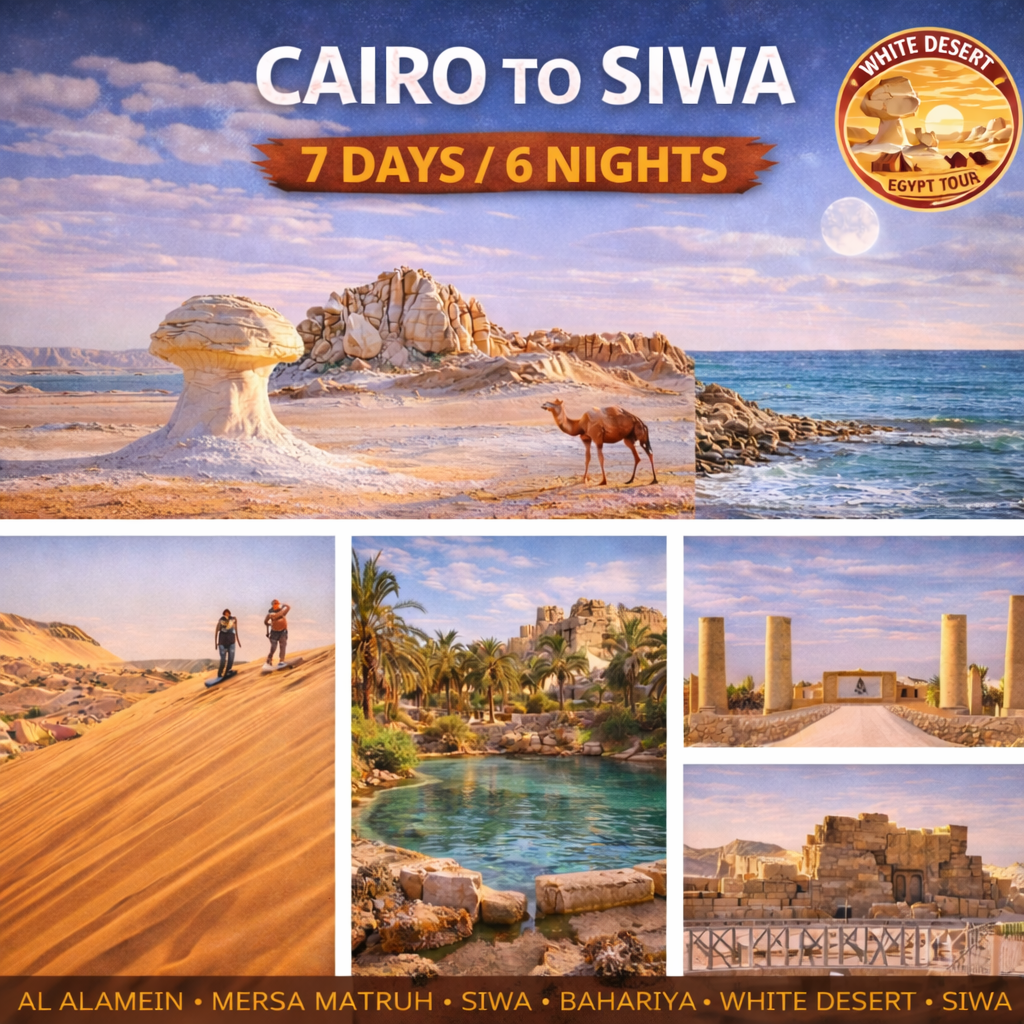
7 Days Siwa & White Desert Tour from Cairo – Ultimate Western Desert Expedition
🏜️ 7 Days Siwa & White Desert Tour from Cairo North Coast – Siwa – Bahariya – White Desert (7…
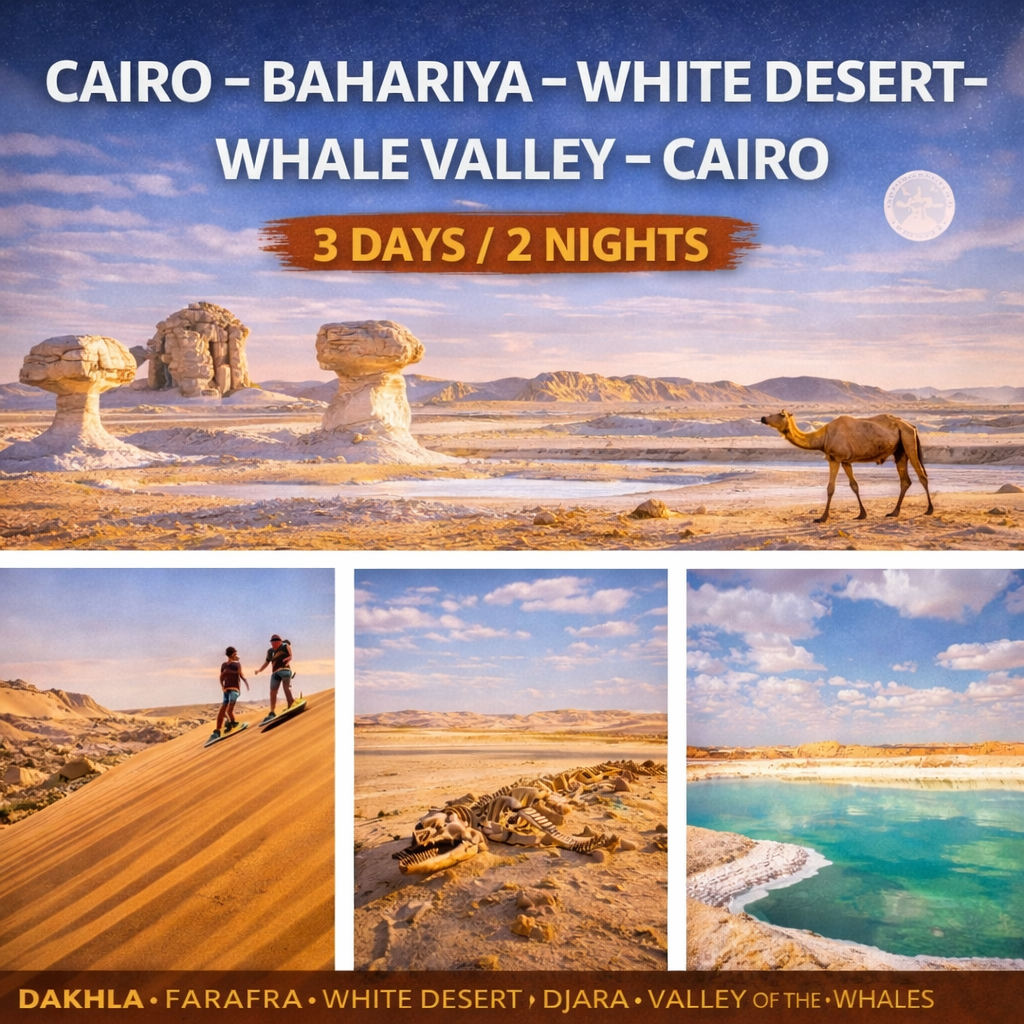
White Desert & Whale Valley Tour from Cairo – 3 Day Desert & Fossil Adventure
🏜️ White Desert & Whale Valley Tour from Cairo Cairo – Bahariya – White Desert – Wadi El Hitan –…
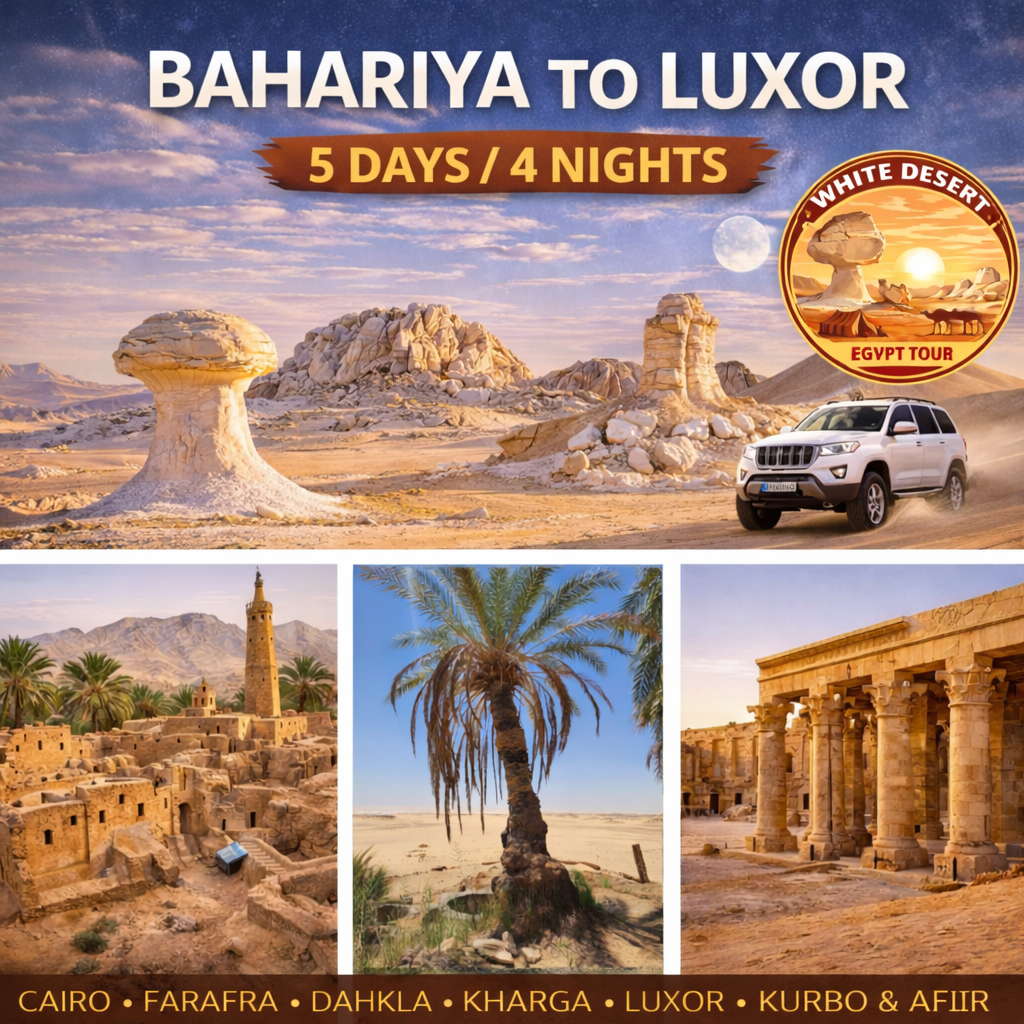
Western Desert Tour from Cairo to Luxor – 5 Day Multi-Oasis Desert Expedition
5 Days / 4 Nights Multi-Oasis Expedition This Western Desert Tour from Cairo to Luxor is a full desert expedition…
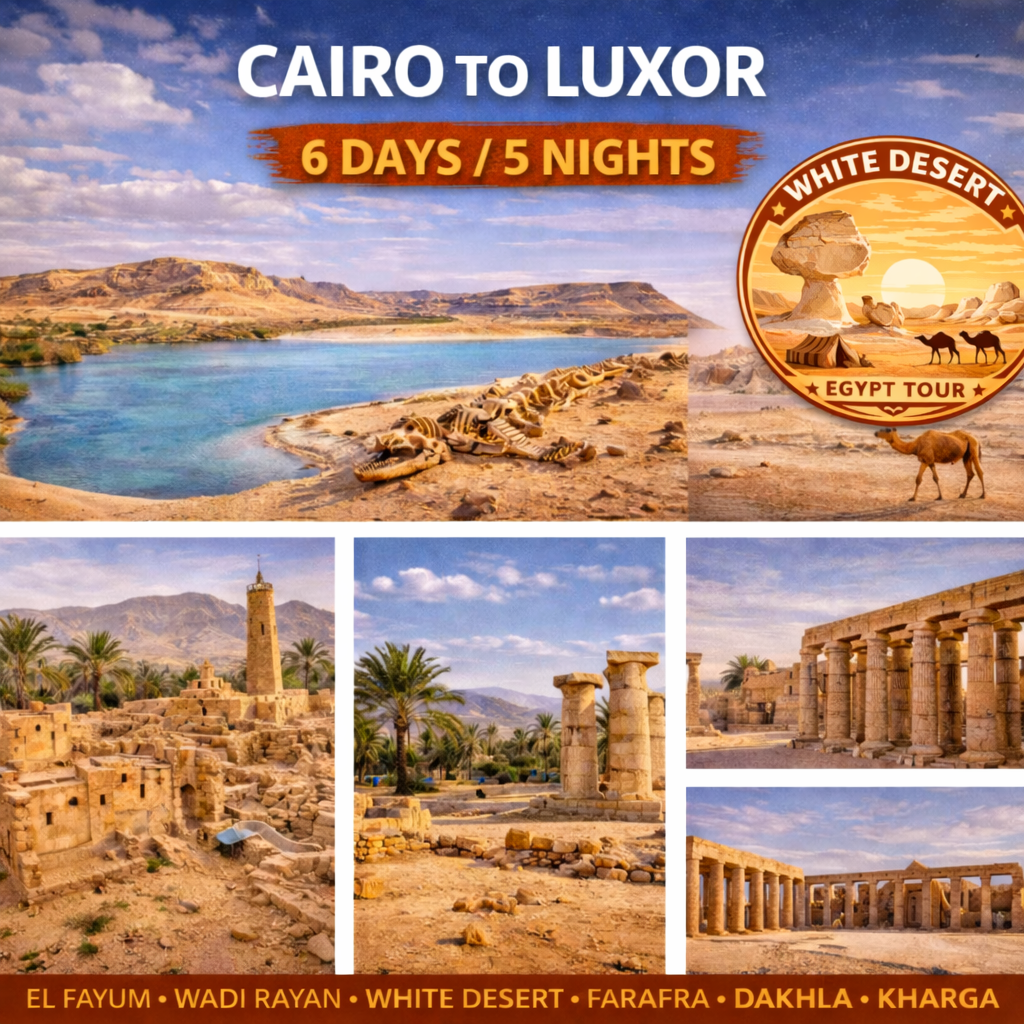
6 Days Western Desert Expedition – Cairo to Luxor Oasis & Desert Safari
🏜️ 6 Days Western Desert Expedition Cairo → Fayoum → White Desert → Dakhla → Kharga → Luxor This 6-day…
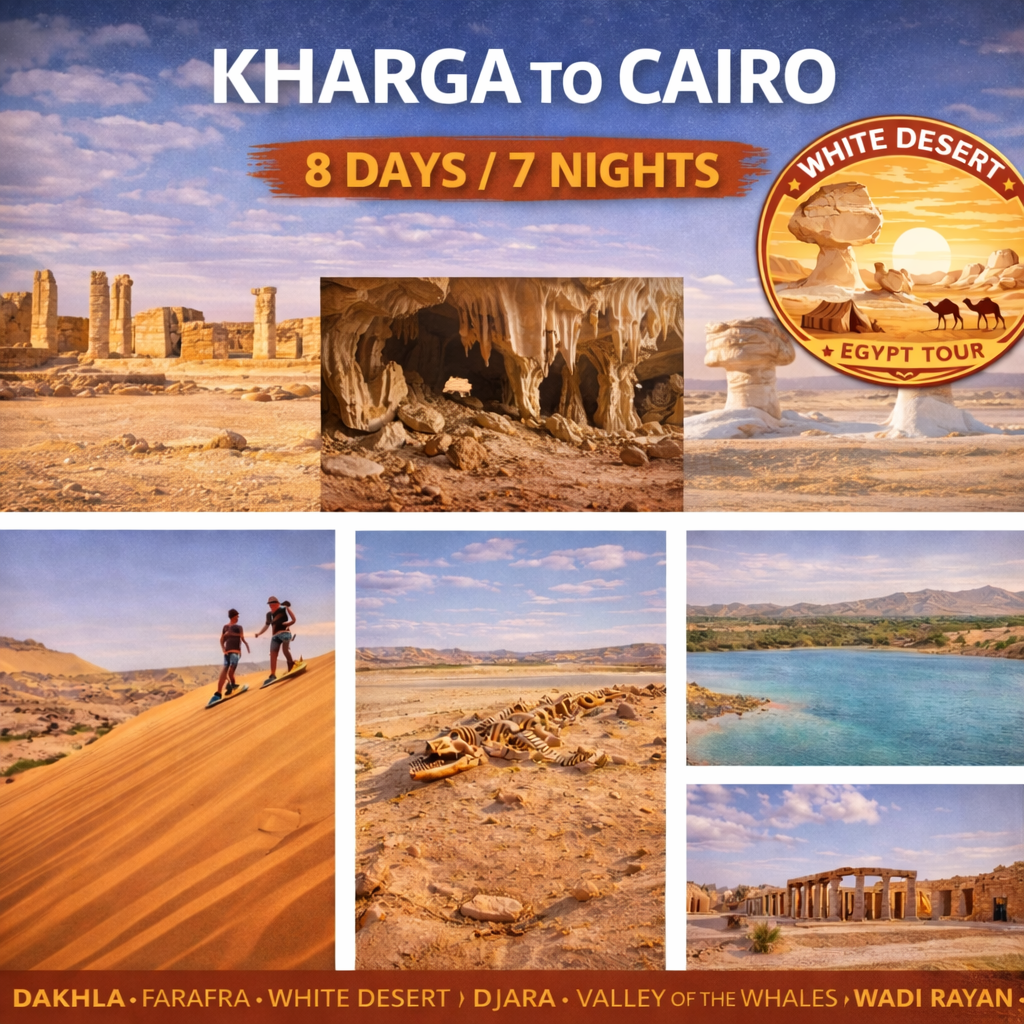
8 Days Western Desert Expedition – Kharga to Cairo Oasis & Desert Adventure
🏜️ 8 Days Western Desert Expedition (Kharga to Cairo) Kharga → Dakhla → Farafra → White Desert → Djara Cave…
Where Is Crystal Mountain in Egypt?
Crystal Mountain is located in Egypt’s Western Desert in the wider White Desert region between Bahariya Oasis and Farafra Oasis.
Academic research places Crystal Mountain in the northern White Desert and describes it as a significant fossil karst and palaeocave feature of the region.
For most travelers, the easiest way to understand its location is through the classic desert safari route.
You normally travel:
Cairo → Bahariya Oasis → Black Desert → Crystal Mountain → White Desert
rather than visiting Crystal Mountain as a completely separate excursion.
The Egyptian Tourism Authority similarly promotes Crystal Mountain as one of the desert excursions associated with Farafra and the White Desert landscape.
If you are planning the complete journey, start with our Bahariya Oasis Egypt guide and our detailed White Desert Egypt travel guide.
You can also use our White Desert Egypt map to understand the wider route.
What Is Crystal Mountain Egypt?
The name Crystal Mountain can create the wrong mental image.
It is not a giant mountain built entirely from crystals.
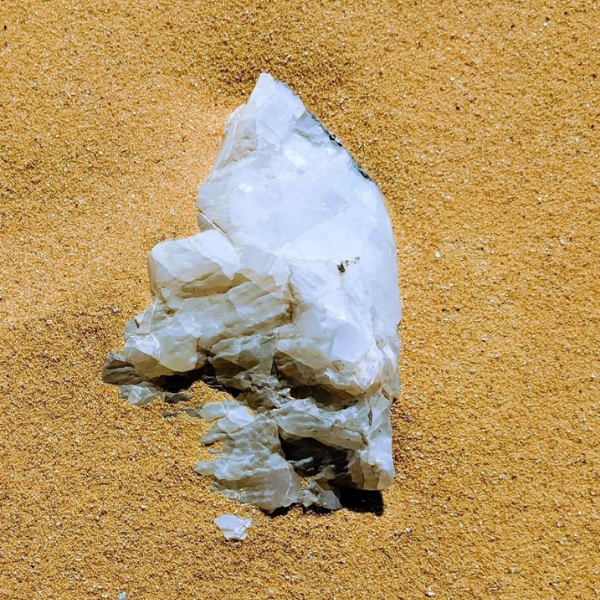
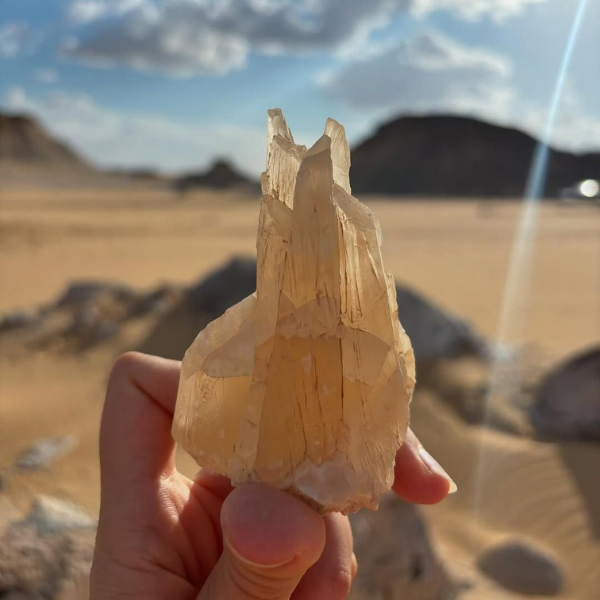
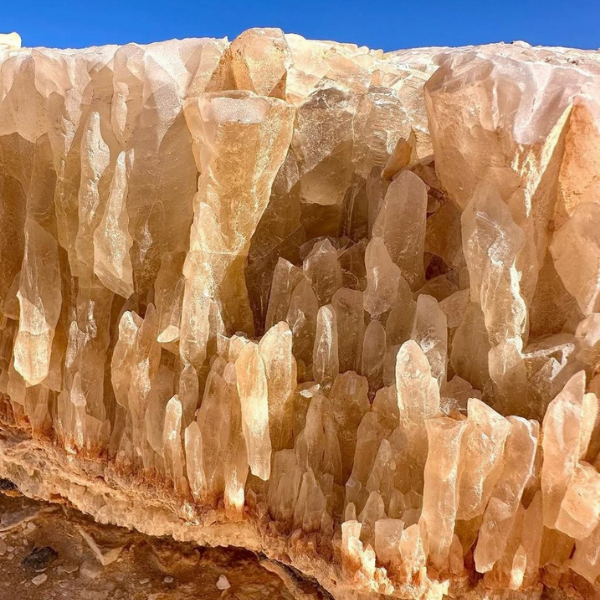
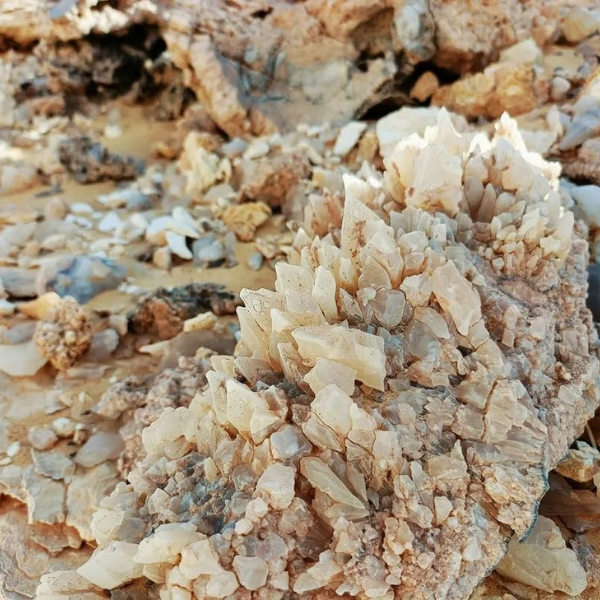
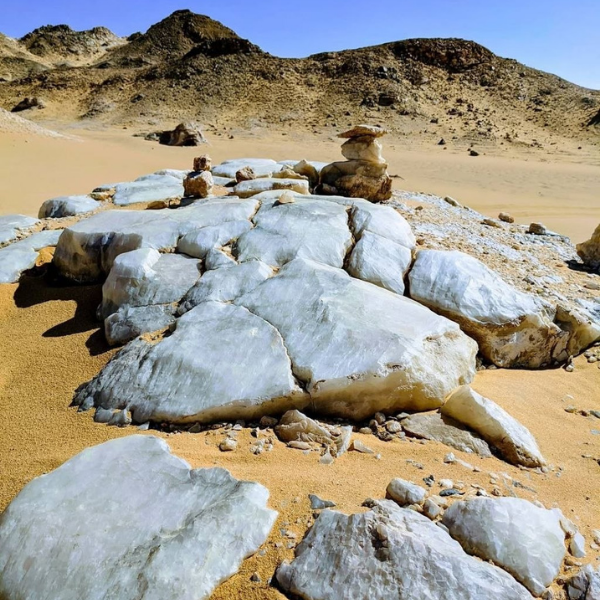
Instead, it is a relatively compact geological formation where crystalline minerals are exposed within an eroded limestone and karst landscape.
A 2025 geological study describes Crystal Mountain, or Gebel Crystal, as a major unroofed cave developed in chalky limestone belonging to the Upper Cretaceous Khoman Formation. The studied cave fill includes calcite crystals along with sedimentary and karst features.
That makes Crystal Mountain particularly interesting because the attraction you see today represents only part of a much older geological system.
The surrounding rock has been modified by dissolution, cave development, mineral deposition, geological change and later erosion.
Eventually, sections of the former underground system became exposed.
Today visitors see the surviving ridge, arches, cavities and sparkling mineral surfaces under the desert sun.
This also explains why describing it as simply “a quartz mountain created by wind erosion” is too simplistic.
Is Crystal Mountain Made of Quartz?
This is one of the most important questions for the page because many tourism websites describe Crystal Mountain as quartz without qualification.
The geology is more nuanced.
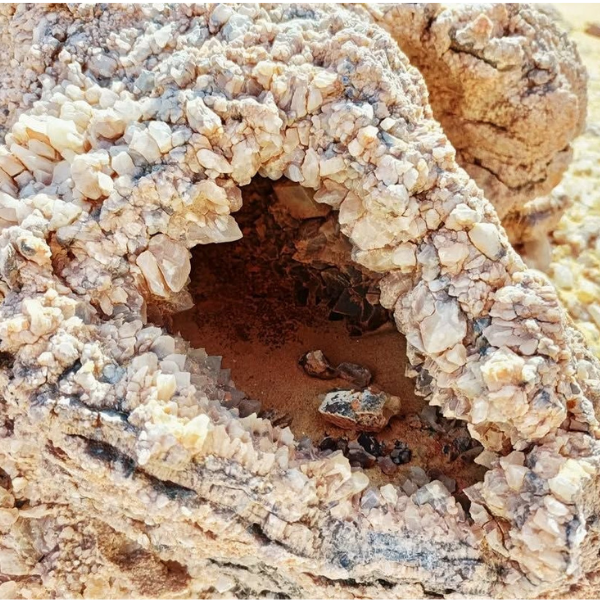
Recent scientific literature describing Crystal Mountain’s karst system specifically reports calcite crystals within the cave deposits. Other geological descriptions of the locality have also associated its sparkling minerals with calcite and, in some accounts, barite rather than simply quartz.
So I recommend not writing:
Crystal Mountain is made of quartz crystals.
A better description is:
Crystal Mountain is an exposed limestone and karst formation containing sparkling crystalline mineral deposits, particularly calcite-rich formations.
This is both safer scientifically and more interesting for readers.
The fact that its geology is frequently oversimplified gives this page an opportunity to offer travelers information they may not find on generic tour websites.
How Did Crystal Mountain Form?
Crystal Mountain’s formation is connected to the karst history of Egypt’s Western Desert.
Karst landscapes develop when soluble rocks such as limestone are gradually altered and dissolved by water.
That may create:
- cavities;
- underground chambers;
- passages;
- fractures;
- caves;
- mineral deposits.
Today, the Western Desert appears extremely dry.
But the region has experienced dramatically different environmental and hydrological conditions over geological time.
Research into the White Desert region identifies extensive karst development throughout the surrounding limestone landscape.
At Crystal Mountain, the process produced a cave system inside the limestone.
Later geological and erosional processes exposed parts of that former underground environment.
Egypt’s official tourism website summarizes this story by describing Crystal Mountain as a former underground cave that became exposed at the Earth’s surface.
This is why the attraction contains shapes that look more like remnants of a cave than a conventional mountain.
The Ancient Palaeocave beneath Crystal Mountain
One of the most fascinating things about the site is that the visible Crystal Mountain is connected to evidence of a much larger palaeocave system.
Research into the geological heritage of the Bahariya and Farafra region describes an extensive fossil cave network associated with Crystal Mountain.
A palaeocave is essentially an ancient cave system preserved in the geological record.
That means the small attraction visited by travelers today can be viewed as a visible clue to a much larger underground landscape that existed in the past.
This geological context makes the site particularly interesting for:
- geology enthusiasts;
- photographers;
- nature travelers;
- students;
- travelers interested in the prehistoric environmental history of the Sahara.
You don’t need specialist knowledge to enjoy Crystal Mountain.
But understanding what you’re looking at makes a 20-minute sightseeing stop much more meaningful.
Why Does Crystal Mountain Sparkle?
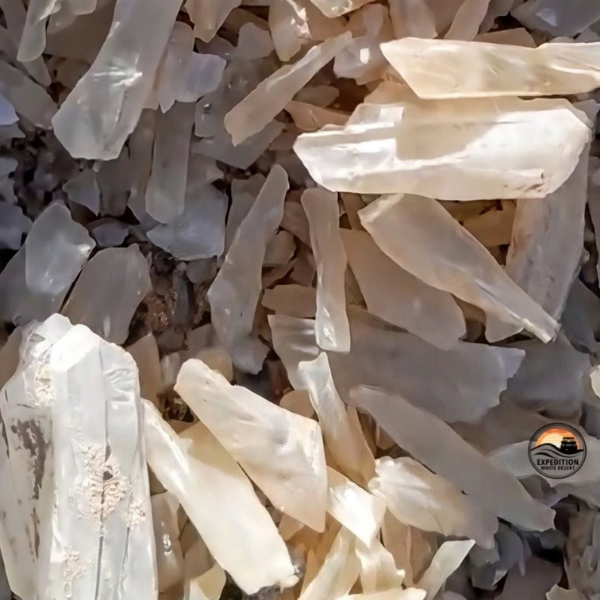
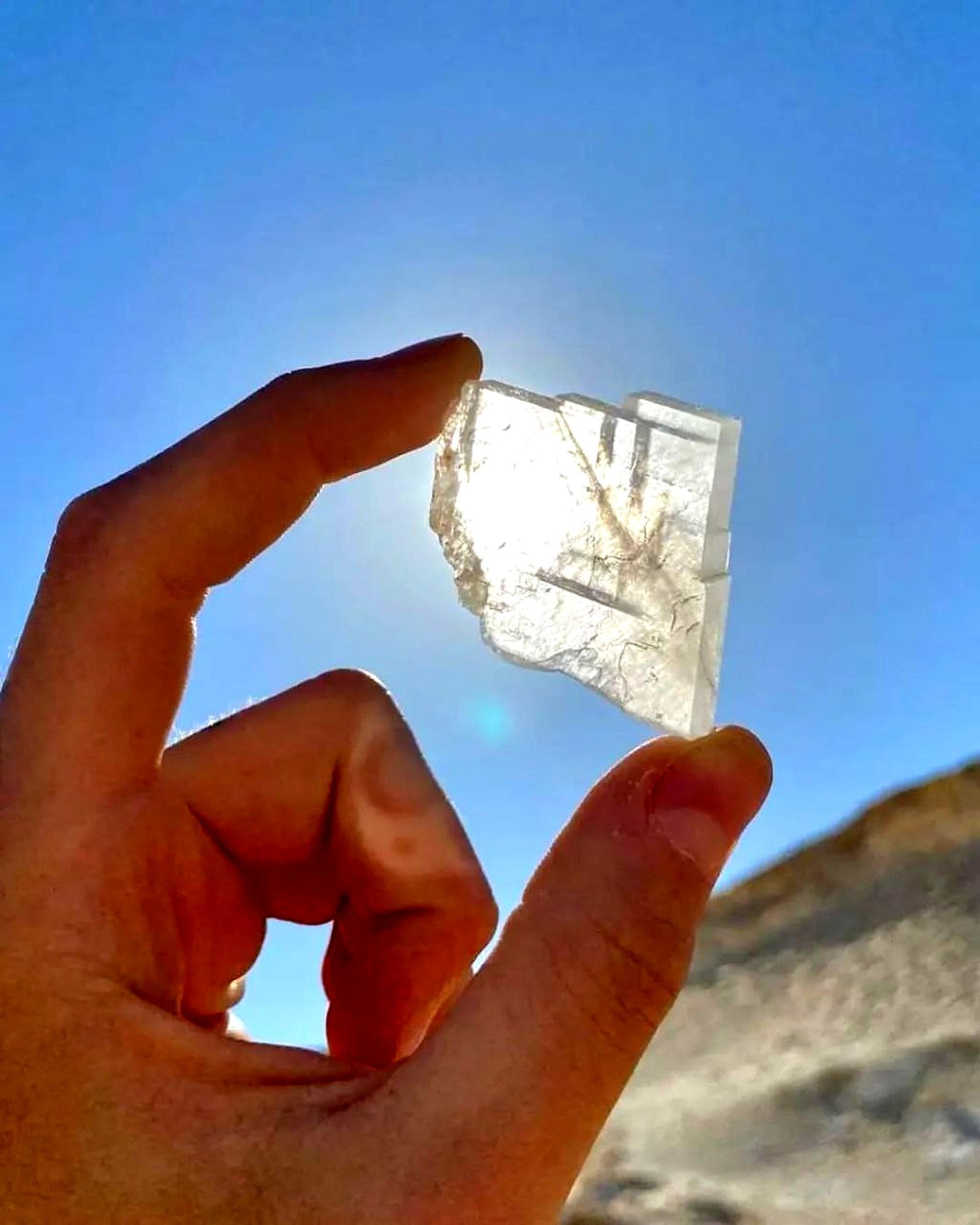
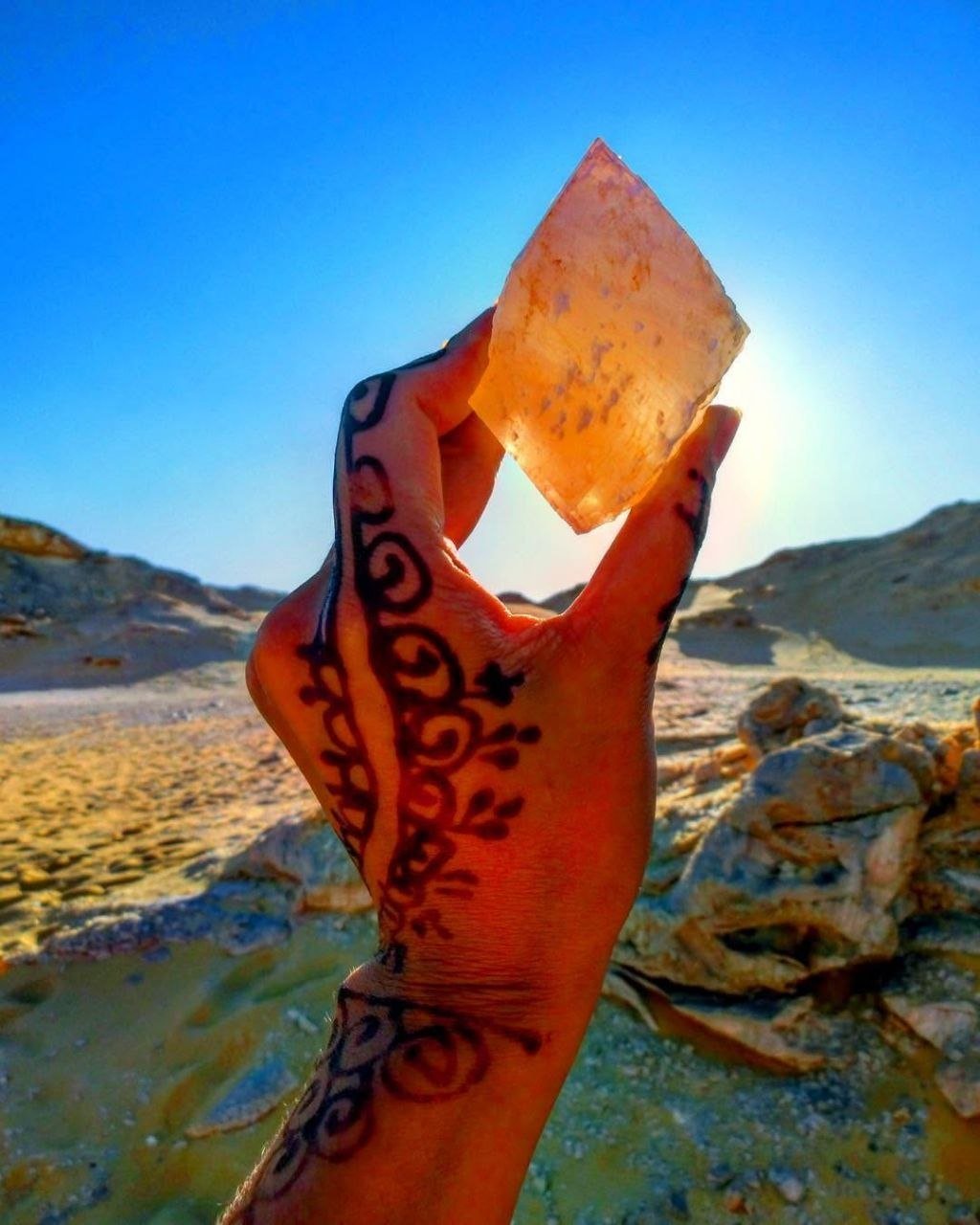
The visual effect comes from exposed crystalline minerals reflecting sunlight.
As you move around the formation, different surfaces catch the light at different angles.
This creates the characteristic sparkling appearance that gave Crystal Mountain its modern tourist name.
The effect changes depending on:
- direction of sunlight;
- time of day;
- viewing angle;
- cloud cover;
- position around the formation.
The Egyptian Tourism Authority specifically highlights how the exposed crystals reflect sunlight as visitors approach the formation.
This is one reason the site can look relatively ordinary from one direction and dramatically brighter from another.
For photography, movement matters.
Instead of taking one photograph from the parking area and returning immediately to the vehicle, walk around the permitted areas and watch how the light changes across different surfaces.
What Does Crystal Mountain Look Like?
Crystal Mountain is smaller than its name suggests.
Travelers expecting a massive mountain range may initially be surprised.
The attraction is better described as a ridge with exposed crystalline rock, cavities and an iconic arch-like formation.
Its small scale is actually part of what makes the stop easy to incorporate into a larger safari.
Visitors can get out of the 4×4, walk around the formation, examine the geology from a respectful distance and take photographs without needing a long hike.
The surrounding open desert is also important.
Crystal Mountain does not exist in isolation.
Its white and pale mineral surfaces sit against broad desert horizons, allowing photographers to capture both close geological detail and wide landscape scenes.
Why Is Crystal Mountain Famous?
Crystal Mountain became famous because several qualities come together in one small location.
Its Sparkling Appearance
The crystalline formations catch the desert sunlight and produce the reflective effect responsible for the site’s name.
Its Geological Story
It is not simply a collection of attractive rocks.
It represents the exposed remains of an ancient karst and cave system.
Its Natural Arch
The arch-like structure is one of Crystal Mountain’s most recognizable visual features and is specifically highlighted by Egypt’s official tourism portal.
Its Location
Crystal Mountain lies directly on one of the classic Western Desert safari routes, making it easy to combine with several much larger attractions.
Its Contrast with Nearby Landscapes
The dark terrain of the Black Desert, glittering Crystal Mountain and chalk formations of the White Desert look dramatically different from one another.
Seeing them within the same journey gives travelers a much better appreciation of the geological variety of Egypt’s Western Desert.
Crystal Mountain on the Black & White Desert Route
Crystal Mountain is best experienced as part of a sequence.
That sequence often begins around Bahariya Oasis.
Travelers leave the oasis and enter increasingly remote landscapes before reaching the White Desert.
A classic route may include:
Bahariya Oasis
The gateway to many Western Desert trips from Cairo.
Palm groves, settlements and cultivated areas make Bahariya a complete contrast to the open desert.
Read our Bahariya Oasis Egypt guide.
Black Desert
The next major landscape is often the Black Desert, known for dark hills and black- and iron-rich surfaces.
Its geology and appearance are very different from Crystal Mountain.
Read the complete Black Desert Egypt guide.
El Haize
Many itineraries include a stop around El Haize before continuing deeper south.
Crystal Mountain
Here the scenery changes again.
The attraction offers a short geological and photography stop before the route continues.
Valley of Agabat
Agabat introduces broad valleys, dramatic rock formations and sandy landscapes.
White Desert
The journey usually reaches its visual climax in the White Desert, where pale chalk formations dominate the landscape.
Many travelers camp there overnight.
Read the complete White Desert Egypt guide.
Your current 3-day White Desert itinerary follows this general sequence, with a 4×4 safari through the Black Desert, El Haize, Crystal Mountain and Valley of Agabat before reaching the White Desert camping area.
Is Crystal Mountain Part of the White Desert?
In travel terms, yes, Crystal Mountain is generally associated with the wider White Desert region and safari route.
Egypt’s official tourism authority directly describes it as “a geographical wonder of the White Desert.”
Geological literature also places Crystal Mountain in the northern White Desert area between Bahariya and Farafra.
However, travelers should understand that Crystal Mountain and the famous chalk sculptures deeper in the White Desert are distinct stops.
You don’t simply arrive at Crystal Mountain and find yourself surrounded by all the famous White Desert mushroom formations.
Instead, it acts as one landmark on the journey toward the wider White Desert landscapes.
Crystal Mountain vs Black Desert vs White Desert
These three destinations are often mentioned together, but they offer completely different scenery.
Black Desert
Best known for:
- dark hills;
- iron-rich surfaces;
- black stones;
- wide viewpoints;
- rugged scenery.
Crystal Mountain
Best known for:
- exposed crystals;
- ancient karst geology;
- natural arch;
- short exploration stop;
- close-up photography.
White Desert
Best known for:
- chalk formations;
- surreal rock sculptures;
- large open landscapes;
- desert camping;
- sunset;
- sunrise;
- stargazing.
Which one should you visit?
You usually don’t need to choose.
The best Western Desert itineraries combine all three.
For travelers specifically researching the contrast between the dark and white landscapes, see our Black Desert and White Desert tour from Cairo guide.
What to Do at Crystal Mountain
Crystal Mountain is not an attraction with dozens of organized activities.
Its appeal comes from observation, geology and photography.
Walk Around the Formation
Take time to walk around the accessible base rather than photographing it from only one angle.
Look for:
- crystal surfaces;
- fractures;
- limestone textures;
- cavities;
- arches;
- changes in mineral color.
Observe the Geology
Once you understand that you’re looking at remnants of a former cave system, many shapes become more interesting.
You begin to notice structures rather than simply “sparkly rocks.”
Take Photographs
The most effective photographs usually combine the crystal formation with the surrounding desert rather than focusing only on close-ups.
Enjoy the View
A Western Desert itinerary can involve significant driving.
Crystal Mountain provides a useful opportunity to get out of the vehicle, stretch your legs and enjoy the open landscape before continuing.
How Long Do You Need at Crystal Mountain?
Unlike the White Desert, Crystal Mountain does not require hours of exploration.
For most travelers, approximately 20–40 minutes can be enough for a normal sightseeing stop, depending on the itinerary and interest level.
Your current 3-day tour describes Crystal Mountain as a short photography stop on the route toward the White Desert.
Travelers interested in geology or photography may naturally spend longer.
The important thing is not to treat the short visit as evidence that Crystal Mountain is unimportant.
Its value comes from the way it adds another geological chapter to the larger desert journey.
How to Get to Crystal Mountain from Cairo
For most international travelers, Cairo is the starting point, but Crystal Mountain should not be treated as a standalone Cairo day trip.
The usual route is:
Cairo → Bahariya Oasis → Desert safari → Crystal Mountain
The Cairo-to-Bahariya portion is generally completed by road.
From Bahariya, travelers continue along the Western Desert safari route, with suitable vehicles used for desert sections of the itinerary.
Your current 3-day tour estimates Cairo to Bahariya at approximately 4–5 hours and then uses a 4×4 vehicle for the desert safari portion.
Because Crystal Mountain sits within a much richer route, driving from Cairo simply to photograph it and return would miss most of what makes the journey worthwhile.
Instead, combine it with:
Black Desert + Crystal Mountain + Agabat + White Desert + camping.
For route planning, see our guide on how to get to the White Desert from Cairo.
Crystal Mountain Tours from Cairo
Crystal Mountain is usually included inside a larger White Desert itinerary rather than sold as a standalone tour.
That is the format I recommend maintaining.
2 Days White Desert Tour from Cairo
The 2-day option works for travelers who have limited time but still want the classic Western Desert route.
The itinerary combines Bahariya with several desert highlights before an overnight White Desert camping experience.
3 Days White Desert Tour from Cairo
The 3-day trip gives travelers more time in Bahariya and a slower overall experience.
Your current itinerary explicitly includes:
Black Desert → El Haize → Crystal Mountain → Valley of Agabat → White Desert, followed by camping.
4 Days White Desert Tour
A four-day itinerary is better for visitors who want the Western Desert to be a major part of their Egypt trip.
The extra time allows for a slower rhythm and more opportunity for photography and exploration.
Crystal Mountain on Longer Western Desert Expeditions
Crystal Mountain is not limited to short White Desert trips.
It can also appear inside longer itineraries combining multiple oases and desert regions.
For example, your 6-Day Western Desert Expedition from Cairo to Luxor includes Crystal Mountain during the Bahariya-to-White-Desert section before continuing toward Farafra, Dakhla and Kharga.
Explore the 6-Day Western Desert Expedition →
Travelers combining Siwa and the White Desert can also see Crystal Mountain during the White Desert portion of the current 7-day itinerary.
Crystal Mountain and Djara Cave
Travelers with more time can combine Crystal Mountain with another very different geological site: Djara Cave.
Djara offers an actual cave environment with stalactites, stalagmites and prehistoric rock art, whereas Crystal Mountain represents an exposed fossil karst system.
Your current 3-day Djara itinerary includes Crystal Mountain on the return route after visiting Djara Cave and the White Desert.
For travelers interested in geology, combining both creates one of the most interesting Western Desert itineraries on the site.
Read our Djara Cave Egypt guide or:
Best Time to Visit Crystal Mountain Egypt
Because Crystal Mountain is normally part of a larger Western Desert trip, the best season is essentially the same as for the White Desert.
For many international visitors, October through April offers more comfortable conditions for outdoor desert exploration and camping than peak summer.
October and November
Good for travelers who want warmer daytime conditions without the strongest summer heat.
December to February
Excellent for daytime exploration, but desert mornings and nights can feel cold.
Warm layers become particularly important if your trip includes White Desert camping.
March and April
Spring offers another useful window before temperatures increase toward summer.
Weather conditions should always be checked before departure.
For detailed month-by-month planning, read our best time to visit White Desert Egypt.
Best Time of Day for Crystal Mountain Photography
If you are interested in photography, lighting makes a noticeable difference at Crystal Mountain.
Morning Light
Low-angle morning sunlight can reveal textures and reflective surfaces more clearly than harsh midday light.
Midday
Strong direct sunlight may increase sparkle on some crystal faces, but high contrast can make landscape photography more difficult.
Late Afternoon
Warm light creates attractive tones in the surrounding desert and can make the ridge stand out against the horizon.
However, your exact arrival time will normally be determined by the larger safari route rather than by Crystal Mountain alone.
Don’t sacrifice the timing of major White Desert sunset or camp experiences just to reach Crystal Mountain at a specific photography hour.
For wider desert photography advice, read our White Desert photography tips.
Photography Tips for Crystal Mountain
Crystal Mountain is one of those destinations where close-up and wide-angle photography tell two completely different stories.
Photograph the Crystal Detail
Capture mineral textures and reflective surfaces.
Move around slightly to find angles where sunlight hits the crystals.
Include the Desert
Do not photograph only the rocks.
Wide photographs showing the formation surrounded by empty desert better communicate the location.
Use a Person for Scale
Because Crystal Mountain is smaller than many travelers expect, placing a person in the frame helps viewers understand its true size.
Photograph the Arch
The exposed arch is one of the most recognizable shapes associated with the site.
Protect Your Equipment
Dust and sand are common during desert travel.
Keep camera bags closed when you’re not using them and minimize unnecessary lens changes during windy conditions.
Don’t Move Crystals for a Better Photograph
A natural geological feature should remain exactly where you found it.
Use composition rather than rearranging the site.
Can You Take Crystals from Crystal Mountain?
You should not remove crystals, stones or geological material from Crystal Mountain.
Even small pieces matter when thousands of visitors pass through the same natural site.
Breaking, collecting or removing material gradually destroys the feature that future travelers have come to see.
There are tourism websites that describe crystal collection as prohibited, but I would avoid making a specific legal claim on your page unless you have an official current regulation in hand.
The stronger and safer wording is:
Please do not break, collect or remove crystals from Crystal Mountain. Leave all geological formations exactly where you find them and follow instructions from your guide and local authorities.
That gives the traveler the correct conservation message without inventing a legal citation.
Responsible Tourism at Crystal Mountain
Crystal Mountain is a geological attraction, not a souvenir source.
Visitors can help preserve the site by following a few simple principles:
- do not break crystals;
- do not remove stones;
- avoid scratching rock surfaces;
- avoid climbing fragile structures;
- take all rubbish with you;
- stay with your guide;
- avoid unnecessary vehicle tracks;
- photograph formations without rearranging them;
- follow current local environmental rules.
Egypt’s official tourism authority encourages travelers heading into the Farafra and White Desert region to check permits and regulations with an authorized guide or travel agency.
Good desert tourism means leaving the landscape as close as possible to how you found it.
Is Crystal Mountain Safe to Visit?
Crystal Mountain should be considered within the context of Western Desert travel, rather than treated like a normal urban attraction.
As of August 2026, the U.S. Department of State advises travelers not to enter Egypt’s Western Desert unless traveling with a professionally licensed tour company.
French travel guidance treats the Cairo–Farafra–Kharga/White Desert zone as compatible with tourism with increased vigilance and strongly recommends using a recognized agency or local guide with appropriate communications, water, food and clothing.
For travelers:
- check your own government’s latest Egypt travel advice;
- confirm current route conditions before departure;
- use an appropriately licensed operator;
- follow Egyptian access requirements;
- carry sufficient water and supplies;
- use suitable vehicles;
- avoid restricted desert and border areas;
- expect limited connectivity in remote sections;
- follow your driver’s and guide’s instructions.
We should not write “Crystal Mountain is completely safe” as an absolute statement.
For more planning information, read our White Desert Egypt safety guide.
Do You Need a 4×4 for Crystal Mountain?
This needs a little nuance.
Crystal Mountain is part of a wider route containing paved-road and desert sections.
The classic Western Desert experience uses 4×4 vehicles for the safari portions, particularly when combining Black Desert, Agabat and the White Desert.
Your current 3-day tour explicitly uses a 4×4 safari vehicle during the desert day that includes Crystal Mountain.
The point is not that the exact Crystal Mountain parking point itself is impossible to approach without four-wheel drive.
The reason visitors use 4×4 vehicles is that the complete desert itinerary involves terrain and routes that ordinary Cairo sightseeing vehicles are not designed for.
What Should You Pack for Crystal Mountain?
Crystal Mountain itself is usually a short stop, but your packing should reflect the entire Western Desert journey.
Bring:
- comfortable closed shoes;
- sunglasses;
- sun hat or scarf;
- sunscreen;
- season-appropriate clothing;
- warmer layers for evening and early morning;
- personal medication;
- small day bag;
- power bank;
- camera or smartphone;
- protection for electronics from sand and dust;
- personal toiletries if camping.
If your trip includes an overnight White Desert camp, don’t pack only for the afternoon temperature.
Desert evenings can feel significantly cooler.
For the complete checklist, read what to pack for White Desert Egypt.
Is Crystal Mountain Suitable for Families?
Crystal Mountain itself is generally a relatively short sightseeing stop.
For families, the bigger question is whether children are comfortable with the complete Western Desert itinerary.
Think about:
- the drive from Cairo;
- time inside vehicles;
- desert temperatures;
- walking on uneven terrain;
- overnight camping;
- children’s ages;
- access to normal facilities.
Families comfortable with outdoor travel may find the changing landscapes particularly enjoyable because children can see several dramatically different desert environments in a short period.
For wider family planning, see our White Desert tour for families.
Is Crystal Mountain Good for Couples and Photographers?
Yes, especially when combined with the White Desert.
Couples often value the wider journey for its scenery, quiet environment, sunset and camping rather than Crystal Mountain alone.
Photographers benefit from the geological variety.
During one trip, you can photograph:
green Bahariya landscapes → Black Desert hills → Crystal Mountain details → Agabat valleys → White Desert formations → sunset → stars → sunrise.
That gives you a far more varied photo series than visiting a single landscape.
Travelers who want photography to be the focus of the journey can also read our White Desert photography tour guide.
Is Crystal Mountain Worth Visiting?
Yes — particularly when it is part of the Black Desert and White Desert route.
Crystal Mountain probably isn’t a destination most international travelers should drive hundreds of kilometers to visit by itself.
That’s not what makes it valuable.
Its strength is its place within the journey.
You leave Bahariya.
The landscape becomes dark in the Black Desert.
Then Crystal Mountain introduces another geological surprise.
Agabat changes the scenery again.
Finally, the White Desert opens into a completely different world of pale chalk formations.
Crystal Mountain adds:
- geological variety;
- sparkling mineral formations;
- an interesting fossil cave story;
- a natural arch;
- photography opportunities;
- a comfortable short break between longer desert drives.
A 20–40 minute stop can still become one of the most memorable visual details of a multi-day safari.
Plan Your Crystal Mountain & White Desert Tour
For most travelers, the best way to visit Crystal Mountain is to combine it with the complete Western Desert route.
A classic itinerary can include:
Cairo → Bahariya Oasis → Black Desert → El Haize → Crystal Mountain → Valley of Agabat → White Desert → Camping → Cairo.
Your current White Desert tours already use this structure, with Crystal Mountain positioned naturally between the earlier desert stops and the White Desert experience.
Short on time?
View the 2-Day White Desert Tour from Cairo →
Want a slower experience?
Explore the 3-Day White Desert Tour from Cairo →
Want more time in the desert?
See the 4-Day White Desert Tour from Cairo →
Want to compare everything first?
Compare the best White Desert Egypt tours →
Ready to plan your trip?
Explore All White Desert & Western Desert Tours →
Contact White Desert Egypt Tour with your travel dates, number of travelers and preferred number of days, and we can help you choose the most suitable Western Desert itinerary.
3 Days Siwa Oasis Tour from Cairo – Great Sand Sea Safari & Oasis Experience
3 Days / 2 Nights Siwa Oasis Tour from Cairo This 3-day Siwa Oasis tour from Cairo is perfect for…
5 Days Siwa Oasis Tour from Cairo – Marsa Matrouh & Great Sand Sea Safari
🏜️ Cairo – Marsa Matrouh – Siwa – Cairo 5 Days / 4 Nights Siwa Oasis Tour from Cairo This…
7 Days Siwa & White Desert Tour from Cairo – Ultimate Western Desert Expedition
🏜️ 7 Days Siwa & White Desert Tour from Cairo North Coast – Siwa – Bahariya – White Desert (7…
White Desert & Whale Valley Tour from Cairo – 3 Day Desert & Fossil Adventure
🏜️ White Desert & Whale Valley Tour from Cairo Cairo – Bahariya – White Desert – Wadi El Hitan –…
Western Desert Tour from Cairo to Luxor – 5 Day Multi-Oasis Desert Expedition
5 Days / 4 Nights Multi-Oasis Expedition This Western Desert Tour from Cairo to Luxor is a full desert expedition…
6 Days Western Desert Expedition – Cairo to Luxor Oasis & Desert Safari
🏜️ 6 Days Western Desert Expedition Cairo → Fayoum → White Desert → Dakhla → Kharga → Luxor This 6-day…
8 Days Western Desert Expedition – Kharga to Cairo Oasis & Desert Adventure
🏜️ 8 Days Western Desert Expedition (Kharga to Cairo) Kharga → Dakhla → Farafra → White Desert → Djara Cave…
FAQ About Crystal Mountain Egypt
Everything you need to know about Crystal Mountain Egypt, including its geology, crystals, location, Western Desert tours, 4×4 access and its connection with the Black and White Desert.
Crystal Mountain is located in Egypt's Western Desert in the wider White Desert region between Bahariya Oasis and Farafra Oasis. It is normally visited during a Western Desert safari rather than as a standalone excursion.
Crystal Mountain is an exposed geological ridge and fossil karst feature associated with an ancient cave system. It contains sparkling crystalline mineral formations and a recognizable natural arch.
Not in the conventional sense. It is better described as an exposed ridge and karst formation rather than a large mountain massif.
It should not be described simply as a quartz mountain. Recent geological research documents calcite crystals within Crystal Mountain's fossil cave deposits, while other geological descriptions discuss a more complex mineral assemblage.
Exposed crystalline minerals reflect sunlight at different angles, producing the sparkling appearance associated with the site. Egypt's official tourism portal specifically highlights this reflective effect.
Yes. Geological research identifies Crystal Mountain as an unroofed or fossil cave system, and Egypt's Tourism Authority describes the attraction as a former underground cave that became exposed at the surface.
Crystal Mountain is associated with the northern White Desert region and is promoted by Egypt's official tourism authority as a geological attraction of the White Desert.
Both attractions are normally visited on the same Western Desert safari route. Travelers commonly see the Black Desert first before continuing toward Crystal Mountain and the White Desert.
For most travelers, around 20–40 minutes is enough for a normal stop, photographs and a short walk around the formation. Geology enthusiasts and photographers may prefer more time.
Visitors should not break, collect or remove crystals or other geological material. Leave the formations exactly where you find them and follow the instructions of your guide and local authorities.
Yes, but it is normally visited as part of a multi-day Western Desert tour. Most itineraries travel from Cairo to Bahariya Oasis before beginning the desert safari route.
Many Black and White Desert itineraries include Crystal Mountain. White Desert Egypt Tour's current 3-day itinerary includes it between El Haize and the Valley of Agabat on the route toward the White Desert.
Suitable 4×4 vehicles are commonly used for the desert-safari sections of the wider Black Desert, Crystal Mountain and White Desert route. The exact route and vehicle requirements should be confirmed before departure.
For many international travelers, October through April offers more comfortable conditions for a wider Western Desert safari than peak summer. Travelers should check current weather before departure.
Crystal Mountain is located within Egypt's Western Desert, so travelers should consult current government travel advice and access requirements. U.S. guidance currently advises Western Desert visitors to travel with a professionally licensed tour company.
They offer different experiences. Crystal Mountain is a short geological stop featuring exposed crystalline formations, while the White Desert is a much larger landscape known for chalk formations, camping, sunset, sunrise and stargazing. Most travelers visit both on the same route.
Yes, particularly as part of a Black Desert and White Desert safari. Its geological story, sparkling formations and position on the classic route make it a worthwhile stop even though most visits are relatively short.
White Desert Egypt Tour TripAdvisor reviews
Nice and Relax - Nice and relaxed desert trip, mohammed is a great tours guide and knows a lot, the private tours is something i recommend, because it gives a good and relax experience,... read more as you want.
October 13, 2026
3 Day and 2 Nights of Fun and Knowledge - This was one of the best experiences of my life. Our guides, Anas and Kareem, were so kind, helpful, and fun. From the food, sites, and experience everything was ABSOLUTELY... read more PERFECT. 100/10 would do again and recommend to any one.
jakewP7022KTOctober 15, 2026
White Desert Tours - We would highly recommend Mohammad’s company for a trip to the White Desert. Very communicative and responsive throughout. The teams priority was to ensure clients had the best experience and... read more they certainly achieved that 100% from drivers meals relaxation photo stops everything was great. The White Desert is not to be missed a truly spectacular experience.
October 22, 2026